



Car Sharing, Car Rental Coverge
The overall car-sharing fleet in the U.S. grew 42% last year, while traditional car rental companies now represent 72% of car-sharing memberships, according to a recent study.

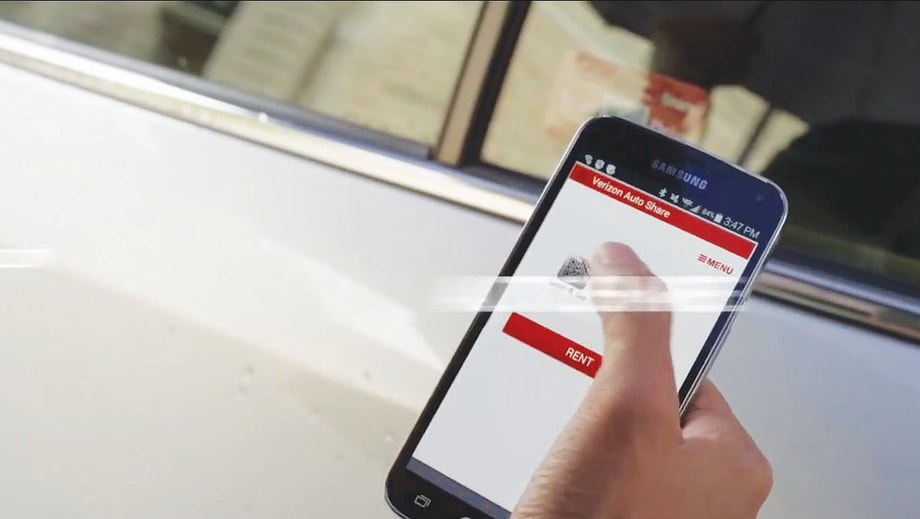
The Verizon Auto Share car-sharing mobile app will be available by the end of 2014. Photo courtesy of Verizon.
The Verizon Auto Share car-sharing mobile app will be available by the end of 2014. Photo courtesy of Verizon.
According to the Transportation Sustainability Research Center’s (TSRC) 2014 CarSharing Outlook, as of Jan. 1, there were 24 active shared-use vehicle systems in the U.S. serving about 1.2 million car-sharing members using 17,179 vehicles.
While small compared to the overall car rental market, between January 2013 and January 2014, car-sharing membership grew 38% in the U.S. while fleets grew 42%, according to the study.
The three largest car-share operators in the U.S. — Zipcar, Enterprise CarShare and car2go — comprised 87.2% of the market in January, while car-sharing programs run by rental companies represented 72% of the car-sharing memberships, according to the study.
Here is an update on the market by company and an announcement of a tech initiative from Verizon.
Zipcar
Acquired by Avis Budget Group in 2013, Zipcar has grown to nearly 30 major markets in the U.S., Canada, the U.K., Spain and Austria, including 30 airports.
This year, Zipcar launched ONE>WAY in select markets, a service that allows users to make one-way or “point-to-point” trips within a specified geographic boundary.
In October, Zipcar announced two new partnerships: to become a car-sharing provider for the General Services Administration (GSA) and to provide memberships to nearly 45,000 Southwest Airlines and AirTran Airways employees in all Zipcar cities.
Enterprise CarShare
Enterprise Holdings has grown its car-sharing initiative, Enterprise CarShare, through the purchase and consolidation of independent networks. Similar to Zipcar, Enterprise CarShare extends its pay-by-the-hour services to individuals and across multiple industries: universities, businesses and government.
The service is available on more than 75 university campuses, 40 U.S. government and business campuses and in nearly 20 major U.S. markets.
This year, Enterprise CarShare has acquired two well-established independent car-sharing brands — Toronto’s AutoShare CarSharing Network and Denver-based OccasionalCar.
In the government sector, Enterprise CarShare was also recently named one of the General Services Administration (GSA)’s car-sharing providers for its one-year pilot car-sharing program.
Enterprise also runs Zimride, an online ride-matching program, and Enterprise Rideshare, a carpooling and vanpooling program for commuters.
Hertz 24/7
In 2013, Hertz rebranded its car-sharing initiative from Hertz On Demand to Hertz 24/7. Last year, the service launched globally and is currently available in several countries, including Australia, Belgium, Canada, Germany, the U.K. and Italy.
Nationally, Hertz 24/7 is available in various cities as well as at college universities.
Hertz has not announced any expansion in 2014. However, by 2016, “the company will be prepared to have approximately 500,000 Hertz 24/7-enabled vehicles in service globally,” the company said in a statement last June.
car2go
Daimler’s car2go, specializing in one-way, point-to-point rentals of smart fortwo vehicles, was operating in eight countries and 27 cities worldwide, as of July 2014.
Nationally, car2go has expanded to several cities this year, including Los Angeles’ South Bay region, Brooklyn, N.Y., and St. Paul, Minn.
In September, car2go acquired RideScout LLC — a ride-sharing system similar to Uber — that allows users to search and compare ground transportation options in 69 U.S. cities.
DriveNow
DriveNow’s car-sharing service is a joint venture between BMW and Sixt Rent a Car. Available in Germany, Austria and San Francisco, DriveNow offers all-electric BMW 1-Series compacts and MINI models.
In San Francisco, DriveNow expanded its electric BMW ActiveE fleet by 80 vehicles to a total fleet of 150 ActiveE vehicles.
Verizon Launches Car-Sharing App
In September, Verizon Enterprise Solutions announced that its Verizon Auto Share car-sharing mobile app will be available by the end of 2014.
Verizon Auto Share is designed to enable rental companies to provide their customers with an enhanced rental experience without interacting with an on-site attendant, says the company.
Using the mobile app on smartphones or tablets, renters can scan a QR-code on the vehicle’s windshield, producing a key fob on the mobile app that allows the driver to unlock and start the vehicle, says the company.
“With urban populations projected to represent 7 out of 10 people by 2050, industry experts note that car usership and peer-to-peer sharing via a mobile application is increasingly replacing car ownership as a core part of the connected lifestyle — particularly among young people,” said Mark Bartolomeo of Verizon.
More Rental Operations
Advantage, Sixt Place Among Top Five in Annual Satisfaction Study
While Enterprise and National retain the top spots in JD Power’s 2026 rankings, the latest customer satisfaction results suggest renters can find competitive service beyond the biggest car rental names.
Read More →
The $100,000 Insurance Trap in Exotic Car Rentals
Exotic rental agencies often rely on customers’ personal auto policies to protect six-figure vehicles. But policy language can dramatically change the coverage for vehicles over $100,000 MSRP.
Read More →
The Booking Is Confirmed, But Is Your Customer Ready to Drive?
For international renters, a confirmed reservation doesn’t always mean they’re eligible to drive. Earlier checks can help operators catch documentation and payment issues before the customer reaches the counter.
Read More →
ICRS 2027 Opens Call for Papers
The International Car Rental Show seeks session proposals on the business, operational, and technology issues facing car rental operators. Submissions are due Jan. 15.
Read More →
Turo to Launch Vehicle Delivery Service
Turo Delivered will let travelers search for vehicles that hosts can deliver directly to hotels, homes, airports, train stations, and other locations.
Read More →
Palm Beach Airport Code Change Creates Car Rental Distribution Gap
A test of rental searches under the old PBI and new DJT airport codes returned largely different sets of brands and vehicles, highlighting a potential distribution problem for rental operators.
Read More →
U-Save Continues Dominican Republic Expansion with Launch in Punta Cana
The new franchise location builds on U-Save’s existing Santo Domingo operation and will begin taking reservations for October 2026.
Read More →
When AI Books the Rental Car, Who Controls the Sale?
As AI moves from comparing rental rates to completing transactions, operators need to understand how travelers find, interpret, rank, and ultimately see their offers. (Part 2 of 2.)
Read More →
European Booked Car Rental Rates Fell 5%, Results Varied by Country
Ireland, Cyprus, and the United Kingdom saw steep declines, while booked rates rose in Poland and Hungary.
Read More →
Is It Time to Rethink Rental Categories?
As traditional economy and compact cars disappear from the market, longtime rental operator Mike DeLorenzo asks whether the industry’s familiar vehicle categories still make sense — and what operators need to rethink along with them.
Read More →