





Submit Your Idea: ICRS 2027 Opens Call for Papers
Hertz, Avis: Parsing the Q3 Headwinds and Tailwinds
Third-quarter results from Hertz and Avis show resilient pricing despite softer travel demand. Meanwhile, higher operating costs, recalls, uneven vehicle depreciation, and international weakness continue to put pressure on profits.
November 15, 2026
One of the clearest headwinds was weaker international travel, though pricing remained relatively firm.
Credit:
Auto Rental News
4 min to read
- Hertz and Avis maintain strong pricing strategies despite a decline in travel demand during the third quarter.
- The companies face challenges from increased operating costs, vehicle recalls, and inconsistent vehicle depreciation.
- International market weaknesses continue to exert pressure on profitability for both Hertz and Avis.
*Summarized by AI
Third-quarter earnings from Hertz Global Holdings and Avis Budget Group paint a mixed picture of the car rental industry heading into the final months of 2026. Rental pricing has held up despite weaker air travel demand, but higher operating costs and uneven vehicle residual values continue to complicate profitability.
Both companies reported improved fleet utilization and generally positive pricing trends. Yet their financial results diverged in revenue performance, fleet composition, and exposure to market pressures.
Hertz reported third-quarter revenue of $2.6 billion, up 5.6% year over year, while adjusted corporate EBITDA increased 15% to $233 million. Avis reported revenue of $3.44 billion, down 2%, and adjusted EBITDA of $513 million, an 8% decline.
Both companies fell short of their earnings expectations.
Softer Travel Demand Meets Resilient Pricing
One of the clearest headwinds was weaker air travel demand, particularly international travel.
Avis cited a 2.8% year-over-year decline in U.S. passenger traffic measured by Transportation Security Administration (TSA) data during the third quarter. The company also reported a 4.6% decline in inbound rental days, while flight capacity into Europe from the Middle East fell 8%.
This softer demand was particularly pronounced in August, contributing to lower rental volume and revenue.
Hertz reported similar pressures from lower TSA passenger volumes and international travel weakness. The company cited the conflict in the Middle East and its effects on inbound and intra-European travel.
Despite those challenges, rental pricing remained relatively firm.
Hertz reported a 5.4% increase in global revenue per day (RPD), including growth of approximately 8% in its core U.S. business and at U.S. airports.
Avis reported modestly positive RPD in the Americas, although its pricing performance improved as the quarter progressed. By September, Americas RPD was nearly 4% higher year over year.
Fleet Utilization Helps Offset Lower Volume
Both companies pointed to fleet utilization as an important factor in protecting profitability.
Avis reduced its Americas fleet by 6.5% year over year, while utilization improved 2.8 percentage points to 74.1%. Rental days declined by less than 3%, demonstrating how improved utilization helped offset the smaller fleet.
Hertz maintained approximately flat global fleet capacity and transaction days while generating higher revenue per vehicle.
Vehicle Costs and Residual Values Remain Uneven
Fleet depreciation and vehicle residual values presented another mixed picture.
Hertz reported net depreciation per unit of $285 per month, consistent with its expectations. The company cited stable residual values in its core U.S. business but softer conditions internationally.
Avis reported consolidated per-unit fleet costs of about $315 per month. In the Americas, per-unit fleet costs increased 7% year over year to $330, reflecting lower used-vehicle residual values and the timing of vehicle dispositions.
Avis also highlighted the financial impact of vehicle recalls. The company entered the quarter with approximately 18,000 vehicles grounded by recalls and ended with approximately 14,000. Grounded vehicles generated about $23 million in depreciation, interest, and related costs during the quarter, excluding lost rental profits.
Higher Operating Costs Pressure Margins
Operating expenses were another shared headwind.
Hertz reported a 6% increase in direct operating expense per rental day, driven partly by higher revenue-related expenses and elevated collision and maintenance costs.
Although revenue per day increased faster than adjusted direct operating expenses, the higher costs limited the benefit of stronger pricing.
Avis faced a different challenge. Its total Americas operating and selling, general, and administrative expenses declined approximately 2%, but rental days fell nearly 3%. As a result, operating expenses per rental day increased about 1% to $42.38.
Avis estimated that the inability to reduce certain operating expenses quickly enough in response to weaker demand reduced quarterly adjusted EBITDA by approximately $14 million.
Looking Into Q4
Both companies indicated that pricing trends entering the fourth quarter were encouraging, although neither suggested that travel demand had fully recovered.
Avis reported that Americas RPD increased approximately 4% in October, helping produce positive revenue growth despite fewer rental days. The company expects pricing growth to more than offset lower rental volume during the fourth quarter.
Hertz also expects continued RPD growth, particularly in its core U.S. business, but anticipates further international pressure and elevated collision and maintenance costs.
The outlook suggests that pricing could remain a relative bright spot even as operators contend with uneven travel demand and persistent expenses.
Quick Answers
Despite softer travel demand, Hertz and Avis maintained resilient pricing in the third quarter.
*Summarized by AI
More Rental Operations

How Better Cleaning Processes Improve Rental Fleet Efficiency
A consistent approach to vehicle cleaning helps rental operators reduce turnaround delays and return vehicles to service without compromising cleanliness.
Read More →
Clean on Paper: Red Flags in Exotic Car Rental Verification
A suspicious $45,000 Lamborghini booking reveals the strengths and limitations of renter verification, from forged insurance documents to coverage gaps and unauthorized drivers. (Part 2 of 3)
Read More →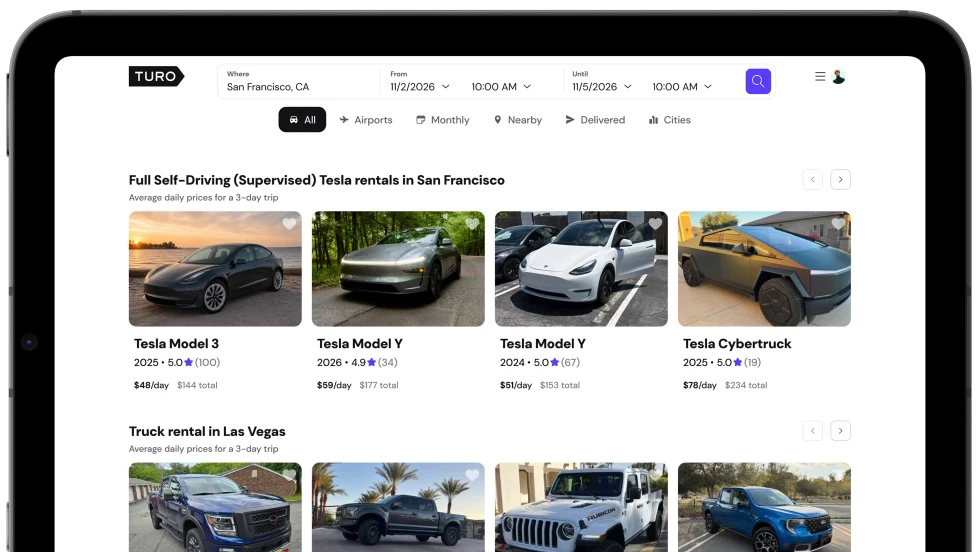
Turo and Tesla Take the Next Step Toward Autonomous Car Rentals
The partnership brings Tesla's Full Self-Driving (Supervised) technology into the rental experience, offering a glimpse of how increasingly automated vehicles could change car rental.
Read More →
How Rental Operators Can Navigate Personalized Pricing Rules
As regulators scrutinize the use of customer data in pricing, rental operators need to know whether they can explain why one renter pays more than another.
Read More →
Direct, Broker or Hybrid? How Travel Retailers Source Rental Cars
As travel retailers weigh direct supplier relationships against third-party distribution, rental operators need to understand how those decisions affect their business.
Read More →
How Did This Independent Rental Operator Grow to 170 Vehicles in 4 Years?
With 170 vehicles across three Kentucky locations, Joel Price relies on an overseas team to handle reservations, payments, and after-hours customer service. It's one part of an unconventional approach to growing an independent rental operation.
Read More →
What Does It Take to Succeed in B2B Rentals?
The fundamentals may be familiar to daily car rental operators, but project-based truck rentals put different demands on the fleet and the business.
Read More →
NPR Builds on International Partnerships to Grow Rental Bookings
With Ana Laborde supporting broker development, NPR Auto Group is tailoring distribution strategies, rate packages, and partnerships to grow international reservations across its three brands.
Read More →
Advantage, Sixt Place Among Top Five in Annual Satisfaction Study
While Enterprise and National retain the top spots in JD Power’s 2026 rankings, the latest customer satisfaction results suggest renters can find competitive service beyond the biggest car rental names.
Read More →
The $100,000 Insurance Trap in Exotic Car Rentals
Exotic rental agencies often rely on customers’ personal auto policies to protect six-figure vehicles. But policy language can dramatically change the coverage for vehicles over $100,000 MSRP.
Read More →