



How Rental Operators Can Navigate Personalized Pricing Rules
As regulators scrutinize the use of customer data in pricing, rental operators need to know whether they can explain why one renter pays more than another.
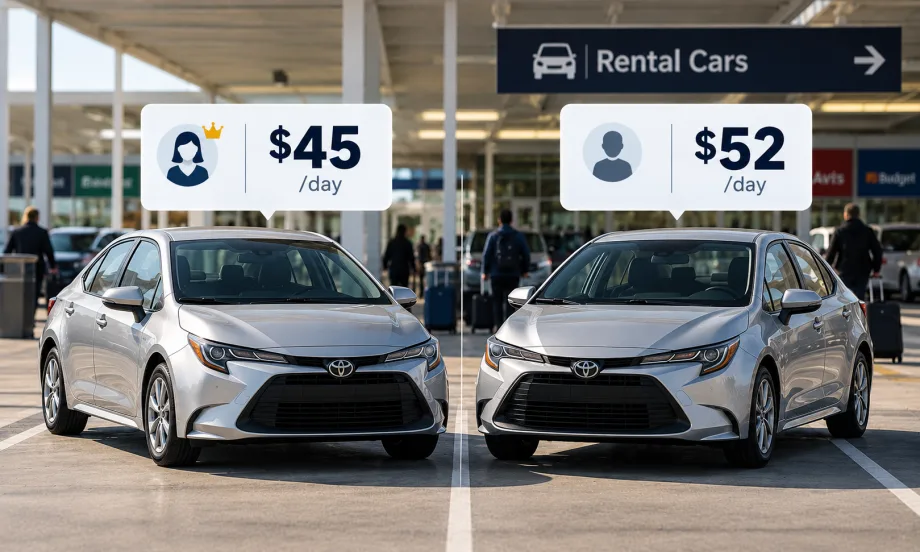
Two renters, the same vehicle, location, and dates — but different rates. The same rental car can carry different prices depending on a customer's rental history and loyalty status.
This image uses elements of AI. Refer to our Terms of Use.
- Rental operators must navigate regulatory scrutiny when implementing personalized pricing based on customer data.
- It's crucial for rental companies to provide clear explanations for pricing disparities between renters.
- Understanding and compliance with regulations are essential to justify pricing models and maintain fairness.
*Summarized by AI
Consider a simple hypothetical: two renters book the same car class at the same airport location for the same dates, and one is quoted $6 a day more. If she asks why, can anyone at the counter or at headquarters show her how that rate was set?
Rates adjusted for fleet availability, utilization, local events, and seasonal demand are ordinary rental pricing, and the proposed, pending, or passed personalized-pricing rules don't treat that kind of demand-based pricing as the problem. Legislators and regulators are concerned when a rate is set, even in part, from personal data about the person booking.
To explain a personalized rate, an operator should retain the data used, the rule or model applied, and the base rate before personalization. Those records provide a practical starting point for answering customer questions and assessing the pricing practice against applicable requirements.
This article offers operators practical guidance as federal and state requirements develop.
What Regulators Are Asking For
On Aug. 19, the Federal Trade Commission proposed an enforcement policy statement on personalized pricing. Where customers reasonably expect one price for everyone, a business that uses personal data to set an individual price would be expected to disclose clearly that the price is personalized, the basis for it, and the types of data used.
The statement is not final. Among the inferences the FTC lists as raising concern when used to raise an undisclosed price is a consumer traveling for a funeral or other urgent obligation. In a hypothetical rental example, a booking flow could read a last-minute, one-way search from an airport as that kind of signal.
Since Nov. 10, 2025, New York state law has required a business that sets a price algorithmically from a New York consumer's personal data to display the words "THIS PRICE WAS SET BY AN ALGORITHM USING YOUR PERSONAL DATA."
That requirement can apply to a personalized loyalty discount as well as to a higher price. In June, the legislature passed the One Fair Price Act, which would go further than disclosure and ban pricing based on personal data, with exceptions for loyalty and membership discounts that meet the bill's conditions. The bill awaits gubernatorial action.
Connecticut's law, which takes effect July 1, 2027, will restrict certain personalized pricing, apply to prices set for groups of consumers as well as individuals, and exclude certain loyalty programs. Both draw the line an operator will have to work with: a loyalty or membership discount on stated terms is treated very differently from a price built from a renter's profile. These rules differ in what they require, and an operator in several states will need counsel's view on each.
Operators serving several states can use a common process to document how they calculate personalized rates, then check each pricing practice and disclosure against the relevant state's requirements.
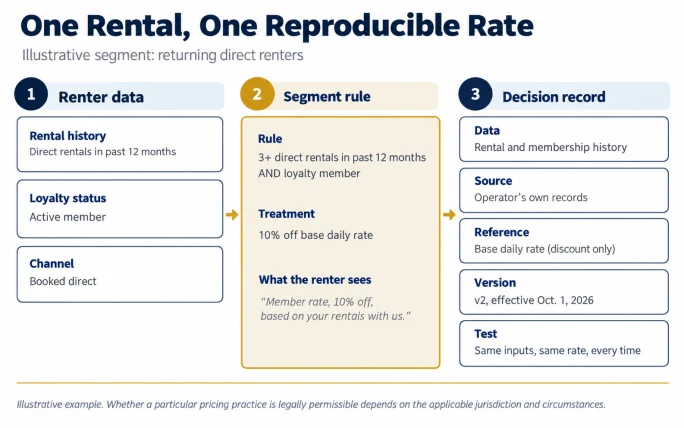
Can you rebuild last month's rental rate? Documenting the customer data, eligibility criteria, and rule version behind a personalized discount helps rental operators explain pricing decisions and reproduce them later.
Auto Rental News
Where Personal Data Enters a Rate
Personal data can determine which discounts a renter qualifies for, which additional products are offered, and the prices quoted for them. Examples include loyalty discounts, corporate rates, offers to previous customers and prices for upgrades or protection products.
A published member rate or corporate discount gives renters a stated basis for the price. Questions become harder to answer when a price reflects the phone used to book, whether the renter booked through an app or website, repeated searches, or demographic information such as household income. If those details affect the quote, the operator should be able to explain how they affected it and why they were relevant.
Explaining a Discount Versus Rebuilding a Rate
Deterministic segmentation groups renters using explicit eligibility rules and applies a defined rate adjustment or offer to each group. The base rate can still change with demand; the same eligibility information and rule version produce the same discount decision.
This gives the operator a specific explanation for the discount: which criteria the renter met and which rule determined the reduction. Data and models can still help identify groups that respond differently to price, while the approved rule determines the production discount.
For example, an operator could offer loyalty members a 10% discount on the base daily rate after three direct rentals in the previous 12 months. Eligibility would be checked against its rental and membership records, with the discount rule recorded as version 2, effective October 1. The customer-facing explanation could read: “10% loyalty discount for completing at least three direct rentals in the past year.” This record explains the discount, but reproducing the full quote also requires the base daily rate that applied at the time.
To rebuild what the renter was quoted a year later, the operator also needs to keep, for each booking: the base rate at the time of the quote and the version of the system that produced it; the inputs that placed the renter in the segment, as they stood at booking; the rule version applied; any other adjustments, such as a corporate code, fees or taxes; and the final rate and the wording the renter saw.
With that, the rate can be recalculated rather than approximately explained.
Compare that with a model that combines device type, home ZIP code, a late-night search, and repeated look-ups for the same dates, decides the renter isn't price-sensitive, and adds 8%. A model can be reproducible too, if the operator logs every input as it stood at booking, keeps the exact model version that ran, and can rerun it.
Without those records, there's no evidence why this renter paid 8% more. Even with them, a rerun shows the output, not a criterion the renter could check. Explainability tools can estimate afterward which variables mattered, but different tools can produce different accounts of the same rate, making it hard to show that the explanation actually set the price.
Which Data Can Move a Rate
An operator's own rental and loyalty history is the easiest data to explain, because the renter generated it and can check it. Demographic data is harder to defend: in a January 2025 Consumer Reports survey, 76 percent of Americans opposed loyalty discounts based partly on characteristics such as age and income.
Connected-vehicle data carries particular risk, and access to it was one of three priorities ACRA members took to Capitol Hill in September. The FTC's final order against General Motors and OnStar in January shows how the agency views that data: GM must obtain affirmative express consent before collecting, using, or sharing connected-vehicle data, and is barred for five years from sharing driving and location data with consumer reporting agencies. Letting driving behavior move a rental rate would invite the same questions.
Operators should approve third-party data, such as broker data or signals supplied by a booking vendor, before it can move a rate, with a record of its source and what the renter agreed to.
Where to Start
The first question a regulator is likely to ask is simple: who pays more than the base rate, who pays less, and why? Few operators simply mark rates up; more often, discounts for some renters sit alongside higher rates for others.
An operator should know which outweighs the other before anyone asks, and should prepare that analysis with counsel, because internal documents on who pays more carry weight in an investigation. None of this requires switching off the current revenue management system:
- Map who pays more and who pays less. Compare each segment's payment to the base rate, how much, and on what criterion.
- Identify each decision that can change a rate or offer. Record the data behind it and the team that owns it, including
- marketing and e-commerce. For each input, note whether it is your own data or a third party’s, a recorded fact or a model’s inference, and whether it can raise a rate or only lower it.
- Write each personalized discount down as a rule. State the criteria, the data source, the treatment against a defined base rate, and an effective date. Revenue management should own the rule; legal and privacy should approve its data. Any input that is inferred, comes from a third party, or can raise a rate needs explicit sign-off.
- Run the rules alongside your current system. Compare rule-based rates with your revenue management system’s, segment by segment, against an acceptable revenue difference set in advance. Generate the renter-facing disclosure from the same record that set the rate.
Whether a practice is lawful in a given state remains a question for counsel. What an operator can check is whether it can answer who pays more, who pays less, and why, for every segment, and rebuild one past rental from the record alone, to the cent: the base rate, segment, rule version, adjustments, final rate, and the sentence the renter saw.
Quick Answers
Personalized pricing is under scrutiny because it involves using customer data, which raises concerns about fairness, transparency, and potential discrimination between renters.
*Summarized by AI
More Rental Operations
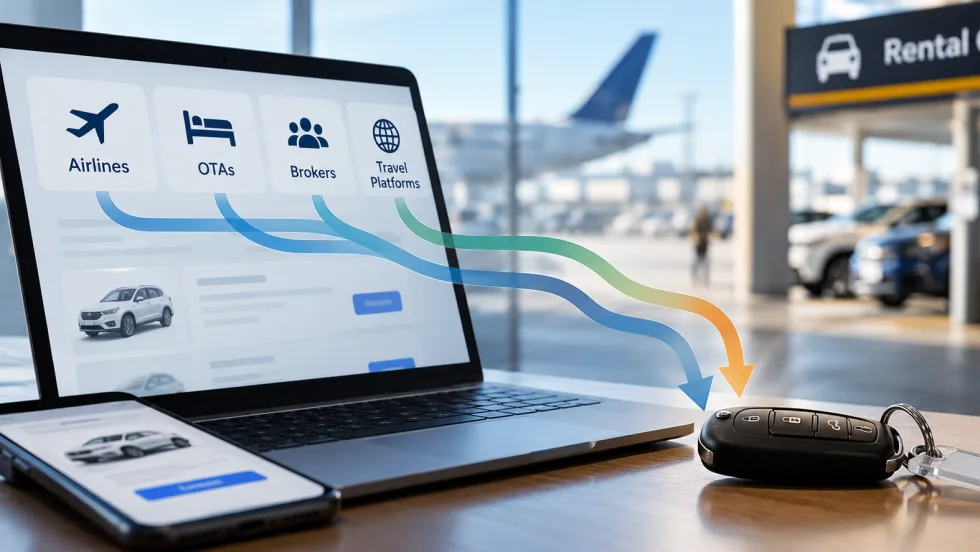
Direct, Broker or Hybrid? How Travel Retailers Source Rental Cars
As travel retailers weigh direct supplier relationships against third-party distribution, rental operators need to understand how those decisions affect their business.
Read More →
How Did This Independent Rental Operator Grow to 170 Vehicles in 4 Years?
With 170 vehicles across three Kentucky locations, Joel Price relies on an overseas team to handle reservations, payments, and after-hours customer service. It's one part of an unconventional approach to growing an independent rental operation.
Read More →
What Does It Take to Succeed in B2B Rentals?
The fundamentals may be familiar to daily car rental operators, but project-based truck rentals put different demands on the fleet and the business.
Read More →
NPR Builds on International Partnerships to Grow Rental Bookings
With Ana Laborde supporting broker development, NPR Auto Group is tailoring distribution strategies, rate packages, and partnerships to grow international reservations across its three brands.
Read More →
Advantage, Sixt Place Among Top Five in Annual Satisfaction Study
While Enterprise and National retain the top spots in JD Power’s 2026 rankings, the latest customer satisfaction results suggest renters can find competitive service beyond the biggest car rental names.
Read More →
The $100,000 Insurance Trap in Exotic Car Rentals
Exotic rental agencies often rely on customers’ personal auto policies to protect six-figure vehicles. But policy language can dramatically change the coverage for vehicles over $100,000 MSRP.
Read More →
The Booking Is Confirmed, But Is Your Customer Ready to Drive?
For international renters, a confirmed reservation doesn’t always mean they’re eligible to drive. Earlier checks can help operators catch documentation and payment issues before the customer reaches the counter.
Read More →
ICRS 2027 Opens Call for Papers
The International Car Rental Show seeks session proposals on the business, operational, and technology issues facing car rental operators. Submissions are due Jan. 15.
Read More →
Turo to Launch Vehicle Delivery Service
Turo Delivered will let travelers search for vehicles that hosts can deliver directly to hotels, homes, airports, train stations, and other locations.
Read More →
Palm Beach Airport Code Change Creates Car Rental Distribution Gap
A test of rental searches under the old PBI and new DJT airport codes returned largely different sets of brands and vehicles, highlighting a potential distribution problem for rental operators.
Read More →