


November 1, 2026
Clean on Paper: Red Flags in Exotic Car Rental Verification
A suspicious $45,000 Lamborghini booking reveals the strengths and limitations of renter verification, from forged insurance documents to coverage gaps and unauthorized drivers. (Part 2 of 3)
Ken Van Vorhis
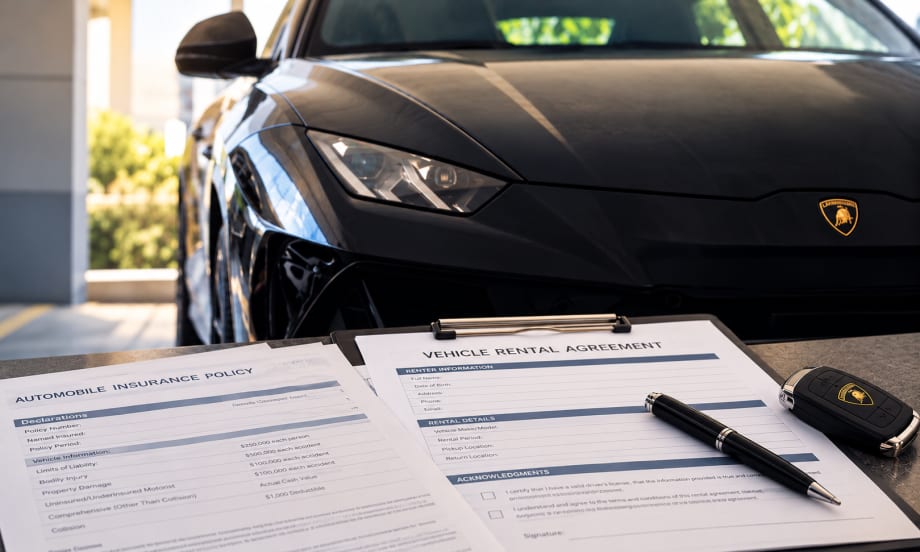
An insurance card may look legitimate even when the underwriting company isn't licensed in the state where the policy was issued. Checking carrier credentials, policy details, and authorized drivers can reveal discrepancies before a vehicle leaves the lot.
Credit:
Image edited with OpenAI. Refer to our Terms of Use.
12 min to read
- A problematic $45,000 Lamborghini rental exposes flaws in the renter verification process.
- Instances of forged insurance documents highlight verification weaknesses.
- Issues like coverage gaps and unauthorized drivers further complicate the rental verification process.
*Summarized by AI
Part 1 of this series examined the insurance coverage gaps that can leave exotic rental operators exposed to six-figure losses. Now we turn to renter verification, to learn what it can miss and why even a clean background check isn't always enough.
Not long ago, a client contacted my exotic rental agency wanting to rent a Lamborghini Urus for three consecutive months. He demanded delivery to San Diego within a couple of hours of his initial request.
A Urus rents for $995 a day, and after our 50% monthly discount, his booking total came out to about $45,000. He didn't push back on the price. In fact, it seemed like he didn’t even read the invoice. He wanted the car immediately and kept pressuring us to rush our renter verification process.
His insurance card said GEICO, and his policy was issued in California. The address matched his driver's license, and his background check came back clean. However, the underwriting company printed on his insurance card was GEICO Secure Insurance Company. That's a real GEICO company, but it isn't licensed to issue policies in California. Something didn’t add up.
We turned the client away and declined the rental. A few weeks later, we heard through the grapevine that he got his hands on a Urus through one of our competitors, and that it never came back.
In 2015, this publication explained how exotic rental agencies protect themselves with "a hefty deposit, from $2,500 to $50,000, running credit and sometimes background checks, and installing GPS devices," in addition to confirming the renter's personal auto insurance. We use the same four tools today. Each one works, and each one answers a narrower question than the one operators trust it with.
My experience comes from operating in California, and for this article we'll cite heavily from GEICO's California personal auto form, the A30CA, which includes many common provisions other carriers in the state carry.
No Single Flag Kills a Booking
Let’s go back to the Urus.
The mismatch on the insurance card was the first red flag and alone doesn’t signal malicious intent, but when we see a red flag we always investigate further.
The name on his license didn't match the name on the card. It was off by a couple letters, possibly a nickname. Once again, on its own this signals nothing. Then we look at the circumstances. A $45,000 booking for three months in a car worth about $150,000. Delivered to San Diego, a short drive from the Mexican border, with no advance notice.
Read the client’s reaction to the price carefully: A renter who doesn't object to the price is normal, and good clients often don't. However, a renter who ignores the price is different. He's not negotiating because he doesn't plan to pay it, or he has other intentions.
Pressure is the biggest red flag of them all. Verification completed under pressure is how mistakes happen, and how a bad booking slips through a good verification process. The renter isn't rushing because he's excited; he's rushing because he’s hoping you miss the details. The unlicensed carrier. The name that's almost right. Those are the exact things a rushed operator overlooks when trying to push through a lucrative booking.
Not to mention, on a three-month rental, his policy wouldn't have covered that Lamborghini at all unless he added it to his declarations page. More on that below.
The background check was clean, and that's the part operators need to hear. A background check tells you the person is real, but it doesn't guarantee your client has good intentions. You can be 100% legit on paper and still have plans to deceive.
No single flag kills a booking, but a stack of incongruencies does.
What the Documents Prove
Renter documents fail verification in a rough order, easiest to fake first.
Insurance Card
It's a one-page document with a name, address, policy number, and phone number. Anyone with an AI tool can generate a fake name and address on a real insurance card, and the Urus card was most likely built in that exact way.
Somebody swapped a name and address onto a real GEICO card, but didn't know enough about insurance to check whether the carrier on the template could issue policies in California.
That's one of the checks we run. Big brands like GEICO issue policies through several underwriting companies, and not every one is licensed in every state. The California Department of Insurance publishes a license lookup; if the company on the card can't write in California, then a California policy from it can’t exist. A forger can copy the logo, but he rarely checks the license.
I caught that fake insurance card by using AI myself while comparing the client’s documents for inconsistencies.
The Declarations Page
Harder to fake than a card because there's more to it — coverages, deductibles, vehicles, drivers, dates, and references to policy contracts and endorsements. More to fake means more to get wrong.
Read it for internal consistency, not for how real it looks. Does the named insured match the license exactly? Does the address match? Do the dates make sense? In 2015, an operator described a card that "looked 100% authentic." They all do now, but an AI can spot inconsistencies with precision we didn’t have in 2015.
Verification services that pull the policy information straight from the carrier with the renter's own login are worth more than any image the renter sends you. Look for services that allow you to verify if a policy is active while simultaneously providing a list of all authorized and excluded drivers, applicable endorsements, and itemized coverages for easy review.
The Carrier's Phone Number
I've heard about this from other operators but haven't seen it myself. A fake insurance card prints a fake carrier’s phone number. Somebody is sitting by that phone, waiting to "verify" the insurance coverages that don’t actually exist.
The fix to this one is simple: Never call the number on the card or the dec page. Instead, find the carrier's official number on Google or the carrier's website, and use that number to call in for verification.
The Listed Drivers
Being on a policy isn't the same as being covered by it. A renter can be listed on their parent's policy, or be named as an excluded driver on a real one. The A30CA policy contract only extends coverage to a car you don't own for "you and your relatives," and a relative has to be "residing in the same household as you." A 22-year-old on his mom's policy who moved out years ago may not be covered in your car at all.
So when you’re on the phone with insurance verifying the coverages, don't ask the representative whether the renter is on the policy. Instead, ask whether this person's comprehensive and collision extend to a rental car. When it's a parent's policy, it doesn’t hurt to talk to the parent or named insured as well.
Credit Card Coverage
Renters will tell you their credit card provides rental insurance, which could be true. American Express and other travel cards offer benefits like this, but with conditions and restrictions. Credit card rental benefits usually require enrollment before they apply, and most cap coverage by vehicle class or vehicle value.
Payment must also be made on the card offering the benefit in order for coverage to apply. Treat credit card coverage as a separate insurance policy that needs its own verification. Most of the time, ask for their personal policy anyway.
The Driver's License
Screening services confirm the license is real and pull the driving record to show tickets, accidents, and suspensions. You can go even further and run a criminal check if you find any red flags.
A criminal record doesn't have to involve cars to matter, because a pattern of bad judgment is a valid reason to decline a rental on a $250,000 car. As the operator, you always have the right to say no.
The Payment Method
Established processors such as Stripe run their own fraud screening, and it catches a lot more than you ever could on your own.
The risk is everywhere else, from cashier's checks and personal checks to a wire or ACH. It’s important to remember that money collected isn’t yours until it's settled in your account. A credit card authorization is a hold, not cash, and even once it's charged, it can be disputed and charged back.
In 2015 an operator described a $50,000 deposit that supposedly cleared, until the bank called 6 days later.
The Policy Can Be Canceled Monday
An insurance verification is only a snapshot of one day.
The policy contract A30CA lets the policyholder cancel their policy whenever they want. "You may cancel this policy by providing notice to us stating when, after the notice, cancellation will be effective." A renter can be verified to drive on Friday, pick up the car on Saturday, and cancel the policy on Monday.
If someone cancels their policy in the time between your verification call and picking up the car, you're probably not going to catch it. Nobody re-verifies insurance on a three-day rental every morning. The solution is to manage the incentive instead.
A rule commonly followed by operators in this industry is to never rent to a client with a policy under 30 days old. Somebody who's already paid a month of premium has no incentive to cancel their policy the day they get the car. A client who bought the policy two days ago specifically for the rental may have purchased it just to pass your verification and may try to cancel it before making their first premium payment.
A new policy alone doesn’t have to be a red flag. If a renter doesn't have coverage under their current policy, and you walk them through switching to a carrier whose coverage does transfer, of course their policy will be new. The question is why the policy is new, and without a clear answer, the car never leaves the lot.
The Additional Risk of Long-Term Rentals
Long rentals are a different problem. Most insurance carriers deny coverage to rentals longer than 30 days or consecutive rentals that add up to more than 30 days, meaning signing a new rental agreement won’t renew the coverage period.
The fix is written into the policy contract. The A30CA's exclusions for rented and leased cars carve out one exception: When the vehicle "is described, and a premium charge is shown for the vehicle for this coverage, in the Declarations Page." So on a long-term rental, the renter must add your car to their policy like it's their own, with comprehensive and collision priced on it.
Now this is where re-verifying a policy makes sense. Verify it before the pickup. Verify again halfway through the rental. Verify it again after that. A renter who adds the car to their declarations page for the first 2 weeks only to drop it when the bill comes due is uninsured for the rest of the rental. Your contract should require the car to stay on their policy for the entire rental.
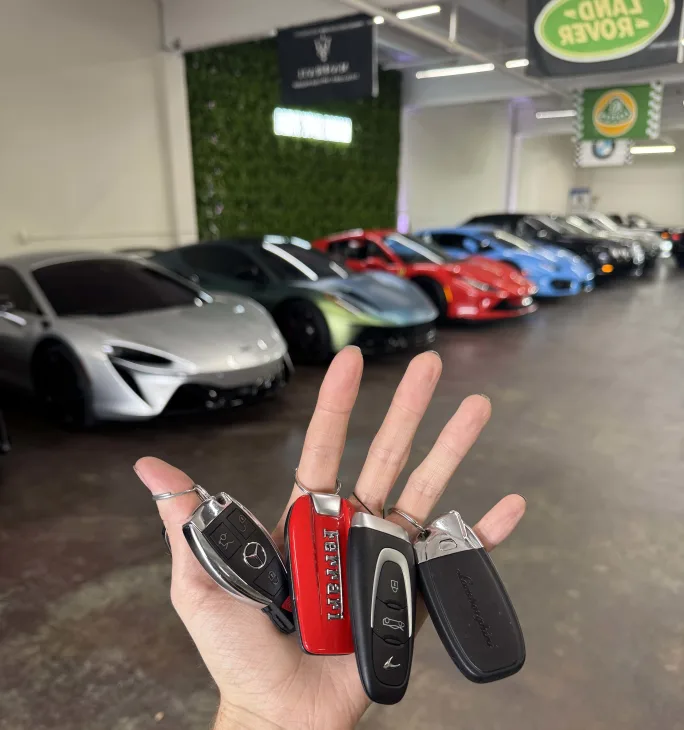
With multiple high-value vehicles in a rental fleet, even one overlooked discrepancy in a renter's insurance or identification can lead to significant financial exposure.
Credit:
Ken Van Vorhis
Who Is Actually Driving
The A30CA policy contract covers the renter in a car not listed on their insurance policy only when they're using it "with the permission or reasonably believed to be with the permission of the owner and within the scope of that permission." The rental agreement is what defines the scope, and the renter whose insurance you called is the person you gave permission to. Anyone else behind the wheel is a stranger to that policy.
That's not a technicality. If someone you never verified is driving when the car gets wrecked, you don't know whose insurance is on that car. You never saw it. There may not be any.
That's why the straw renter matters. The most common example is a group of friends sharing the cost of renting an exotic for the weekend. One friend verifies the rental, and somewhere along the line, their unverified friends end up behind the wheel.
In most cases, it’s not even intentional or deceptive; the client doesn’t understand how insurance coverage works. It’s up to the operator to ask the right questions, and oftentimes those questions will reveal malicious intent as well.
We had a request for a McLaren Artura. The renter said it was for their friend's birthday. That’s perfectly fine, as long as we verify their friend as well. Then the story changed. Suddenly the friend whose birthday the car was rented for wouldn't be driving at all, and only the renter would? We cut the deal off immediately.
Another time a 17-year-old called us. We declined, of course, because he was 17. Less than an hour later, his friend called trying to rent the same car. We declined that one too.
Watch the calendar. If you decline a renter on a specific car for specific dates, then magically a second request comes in for the same car on the same dates, then miraculously a third, somebody is shopping for an approval. Pull that car for those dates and protect yourself, because a booking where the verified renter isn’t behind the wheel is a coverage gap before it becomes a fraud problem, and after the keys change hands, it's too late.
Verify Every Authorized Driver
That’s why prevention comes first. Ask every renter up front, "Is anyone else driving, or just you?" Better yet, offer it. "Do you want to add any other drivers?" Make it easy, and most groups will add their friends. Every driver you add is another license you checked and another policy behind the car.
Then put it in writing. List every authorized driver on the rental agreement, and have each one sign it. This ensures everyone behind the wheel is equally responsible for the car. Add a clause that only listed drivers can drive, and if anyone else is found behind the wheel, the renters are personally liable for all damage. This gives you a breach-of-contract claim you can pursue to recover damages.
However, enforcing that claim in court is slow and expensive. It's the last layer of protection and one you never want to have to use, but it changes the math. If 3 friends signed the rental agreement and a 4th crashed the car, you're not chasing 1 person for the damages. You can go after all 3.
Don’t be afraid to ask around. The exotic car rental industry is small, and most agencies in a market know each other. When one declines a renter, the others usually hear about it.
Part 3: When Verification Isn't Enough
Even the most thorough renter verification process has its limits. Confirming coverage and identifying potential warning signs can reduce risk, but they cannot eliminate it.
Once the keys change hands, operators must rely on other safeguards to protect their vehicles — and those safeguards have limitations of their own.
In the next installment, we'll examine what security deposits, GPS tracking, and telematics can and cannot protect against, along with a potentially greater financial exposure: what happens when a verified renter crashes a vehicle but refuses to cooperate with an insurance claim.
Quick Answers
Common red flags include forged insurance documents, coverage gaps, and unauthorized drivers attempting to rent high-value vehicles.
*Summarized by AI
Loading data...