


Car Sharing: Grading the College Campus Market
Northcoast Research Partners’ report on adoption of car sharing at U.S. universities shows a yearly growth rate of 20-30 percent on a majority of campuses that start a program.
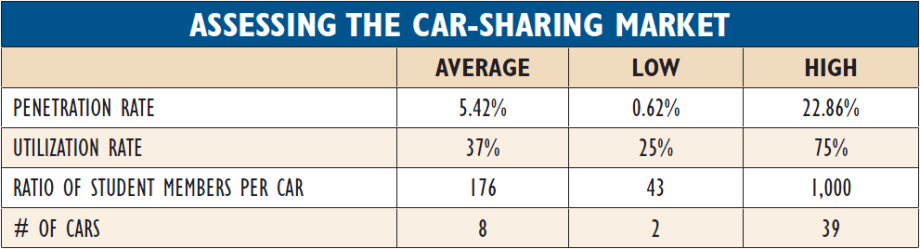
The 35 transportation directors and administrators that took the survey estimate an overall student body usage rate of about 5 percent on average, with the highest going up to almost 23 percent. The higher percentages correlated with the length of the program, with the longest-running programs reporting the highest amount of members. Almost half of respondents also reported that car sharing is becoming a more "mainstream" idea on campus.
Northcoast Research Partners recently completed a quantitative survey and conversations with 35 college transportation directors and administrators regarding the adoption of car sharing on their college campuses. Based on Northcoast’s research, the college campus market remains a small but emerging market for car-sharing operators.
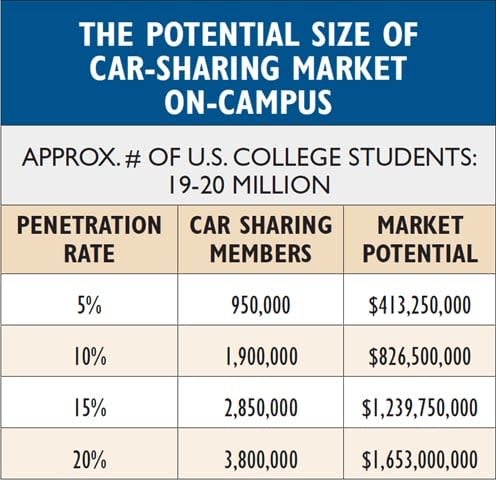
This is an estimated outlook of what the market would look like if penetration rates continue to rise with members utilizing the service at 40 hours per year at a $35 annual fee and $10-per-hour rental fee. With a U.S. student population of about 19-20 million, according to the National Center for Education Statistics, Northcoast estimates that if about 20 percent of students used the program at these same rates and fees, the industry could boast a market size upwards of $1.6 billion.
This research finds that most college campuses that start a program see sizeable growth rates in car sharing usage, growing 20-30 percent on a year-over-year basis. Colleges and universities with car sharing already “fully deployed” for two to three years are experiencing total student body adoption rates of about 10-15 percent.
Northcoast estimates that if all colleges and universities in the country deployed car sharing, the market size could evolve to $400 million to $1.65 billion in total revenues on the long term, assuming that membership fees and hourly usage rates remain consistent, and the penetration rate across the entire U.S. hovers around 5-20 percent.
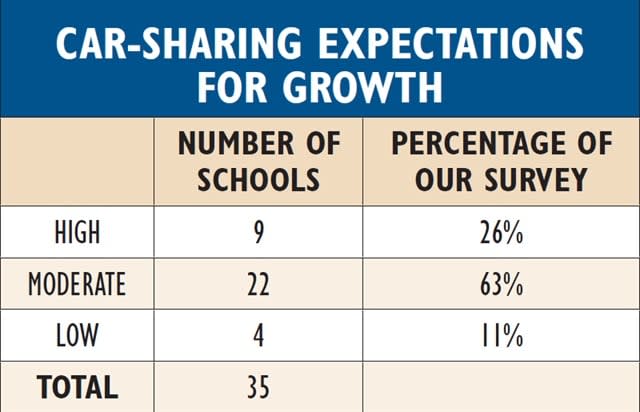
Schools expect the growth of members and fleet to approximate 20-30 percent in the near-future as offerings become better known and embraced by students.
College campuses are looking at car sharing as an integral component of student life and campus parking/transportation strategies. The proliferation of car sharing on college campuses is a result of the following factors: schools looking to reduce the number of cars on campus, students looking to fill transportation needs, increased flexibility by members to “go as they please” and overall efforts to be “green.”
Without question, car sharing is on its way to becoming mainstream in a number of top car-share markets and college campuses. In our opinion, 2011 and 2012 will stand as important years for the car-sharing market as we begin to learn more about consumer adoption and get a better view of competitors.[PAGEBREAK]
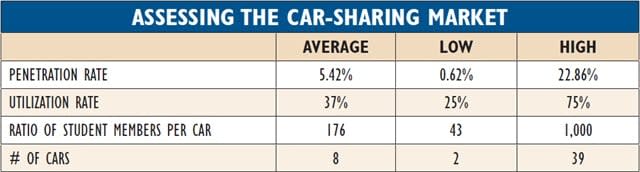
The 35 transportation directors and administrators that took the survey estimate an overall student body usage rate of about 5 percent on average, with the highest going up to almost 23 percent. The higher percentages correlated with the length of the program, with the longest-running programs reporting the highest amount of members. Almost half of respondents also reported that car sharing is becoming a more "mainstream" idea on campus.
Here are Northcoast’s key takeaways from our conversations with transportation directors:
● Universities appreciate the car-sharing model as it “cuts down” on the need for students to bring vehicles to school; it reduces issues with congestion and lack of parking — two issues that many schools encounter.
● Colleges and universities are marketing car-sharing offerings as a way to differentiate themselves to rival schools and also as a way “to promote environmental friendliness campaigns.”
● Schools with programs expect the growth of members and fleet will approximate 20-30 percent in the near future as the offerings become better known and embraced by students.
● Schools typically see car-sharing utilization rates highest on the weekends and lowest during the midweek — similar to car-sharing use in urban settings.
● The biggest complaint is in regards to vehicle shortages primarily on the weekend.
● Car-sharing gives way to additional innovation as “second generation” car-sharing initiatives begin to emerge, such as ride sharing and community vehicle programs.
● Two-way texting and use of mobile apps are popular and give students the ability to reserve vehicles on the go.
● Applications created by operators like Zimride, a carpooling/brokering community, provide for a “car-light” operating environment.
● There is an element of rising competition on college campuses as rental car companies begin to explore the market.
● Some transportation directors feel the future could bring multiple drop-off and pick-up locations for cars for better accessibility.
Car-Share Marketing
Our research suggests that colleges and universities are deploying additional marketing campaigns in an effort to increase the use of car sharing on campus.
The following are methods used by colleges and universities to market car sharing:
● Marketing campaigns during freshmen orientation programs.
● Regularly available marketing materials on campus.
● Monthly email campaigns to student bodies.
● On-campus car-sharing representatives during program launch.
● Campus signage (e.g. flyers, banners, and bus shelters).
While the competitive environment will likely get more crowded in time, increased attention from viable competitors has yet to have any meaningful impact on the near-term results of Zipcar, for example, the largest on-campus car-sharing provider and largest car-sharing company in the U.S.
The market as a whole remains fairly small at this time, but Northcoast believes the growth opportunity associated with cars on college campuses remains significant.
John Healy, a research analyst with Northcoast Research Partners, covers the car rental sector within his business services area of focus. Northcoast Research Partners is an institutional equity research firm that specializes in car rental, among many other industries.
More Rental Operations

How Did This Independent Rental Operator Grow to 170 Vehicles in 4 Years?
With 170 vehicles across three Kentucky locations, Joel Price relies on an overseas team to handle reservations, payments, and after-hours customer service. It's one part of an unconventional approach to growing an independent rental operation.
Read More →
What Does It Take to Succeed in B2B Rentals?
The fundamentals may be familiar to daily car rental operators, but project-based truck rentals put different demands on the fleet and the business.
Read More →
NPR Builds on International Partnerships to Grow Rental Bookings
With Ana Laborde supporting broker development, NPR Auto Group is tailoring distribution strategies, rate packages, and partnerships to grow international reservations across its three brands.
Read More →
Advantage, Sixt Place Among Top Five in Annual Satisfaction Study
While Enterprise and National retain the top spots in JD Power’s 2026 rankings, the latest customer satisfaction results suggest renters can find competitive service beyond the biggest car rental names.
Read More →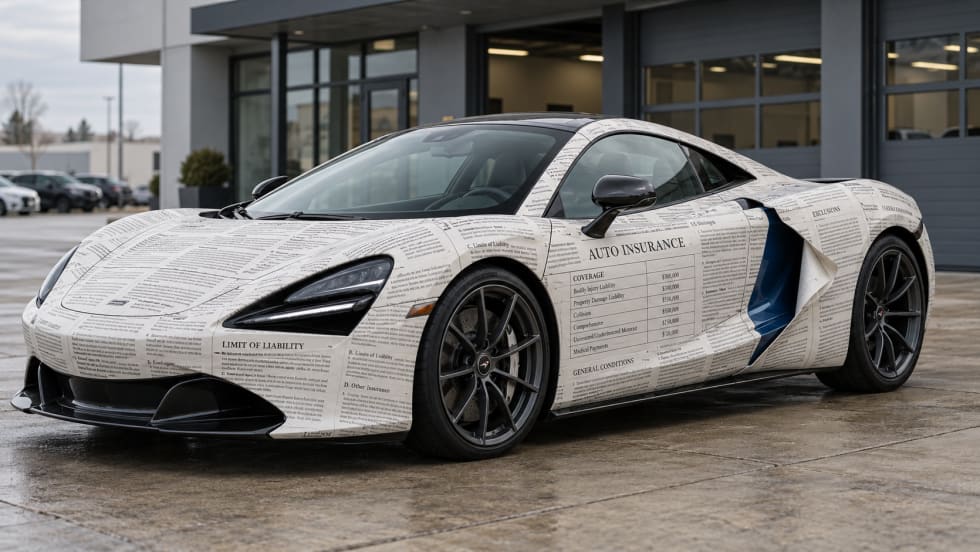
The $100,000 Insurance Trap in Exotic Car Rentals
Exotic rental agencies often rely on customers’ personal auto policies to protect six-figure vehicles. But policy language can dramatically change the coverage for vehicles over $100,000 MSRP.
Read More →
The Booking Is Confirmed, But Is Your Customer Ready to Drive?
For international renters, a confirmed reservation doesn’t always mean they’re eligible to drive. Earlier checks can help operators catch documentation and payment issues before the customer reaches the counter.
Read More →
ICRS 2027 Opens Call for Papers
The International Car Rental Show seeks session proposals on the business, operational, and technology issues facing car rental operators. Submissions are due Jan. 15.
Read More →
Turo to Launch Vehicle Delivery Service
Turo Delivered will let travelers search for vehicles that hosts can deliver directly to hotels, homes, airports, train stations, and other locations.
Read More →
Palm Beach Airport Code Change Creates Car Rental Distribution Gap
A test of rental searches under the old PBI and new DJT airport codes returned largely different sets of brands and vehicles, highlighting a potential distribution problem for rental operators.
Read More →
U-Save Continues Dominican Republic Expansion with Launch in Punta Cana
The new franchise location builds on U-Save’s existing Santo Domingo operation and will begin taking reservations for October 2026.
Read More →