


Revealing the Car-Share Experience
Six car-sharing users reveal their reasons for joining a car-share service, how they use them and how they deal with issues such as parking, availability and time management.

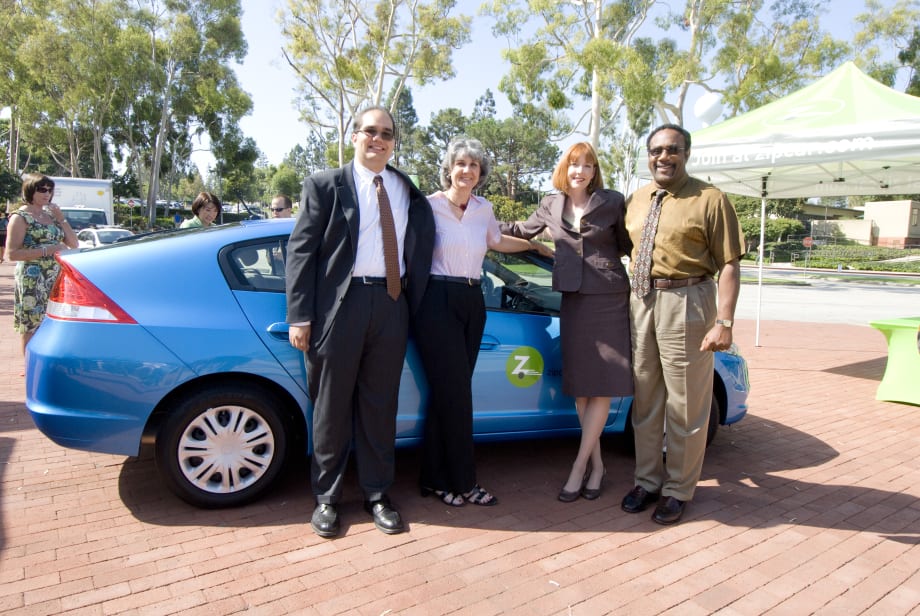
Photo by Victoria Sanchez
In 2009, California State University, Long Beach officials welcomed the launch of Zipcar on campus, which now includes six vehicles. From left to right: Chris Chavez, student government president from 2009-2010; Mary Stephens, VP, administration and finance; Elissa Thomas, alternate transportation coordinator; and Doug Robinson, VP, student services.
As they expand from urban areas and college campuses, car-sharing services such as Zipcar, Hertz On Demand and Enterprise’s WeCar are evolving to form partnerships with city governments and the corporate world. But is car sharing for everyone?
These six car sharers, from professionals to university students, reveal their experiences on how they coordinate car sharing with other forms of transportation and deal with issues such as parking, availability and time management. Through it all, their views on car ownership have changed.
Reasons for Joining
Lisa King lives in Washington, D.C. and has been a Zipcar member for six years. Her car was 10 years old when she decided to join, and it needed extensive work. At the time, King had a job change and realized she didn’t need her car for work anymore since she was no longer going to be in sales. Meanwhile, Zipcar put in two vehicles at the Metro station next to her apartment. Then, her building began to charge for parking. “So I thought, ‘I could ditch my car completely,’” King says.
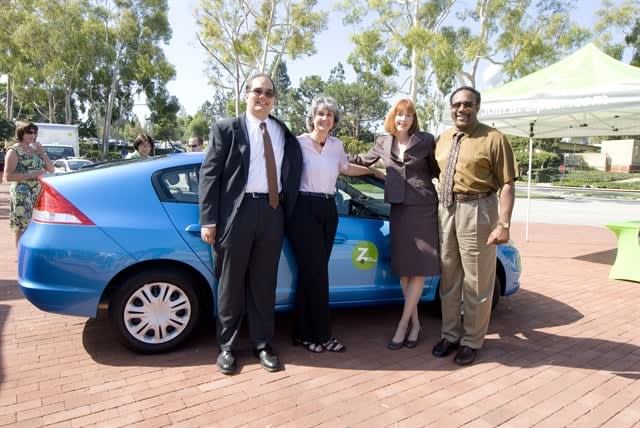
Photo by Victoria Sanchez
In 2009, California State University, Long Beach officials welcomed the launch of Zipcar on campus, which now includes six vehicles. From left to right: Chris Chavez, student government president from 2009-2010; Mary Stephens, VP, administration and finance; Elissa Thomas, alternate transportation coordinator; and Doug Robinson, VP, student services.
And she did, and hasn’t owned a vehicle since. “Now, I spend less on driving than I did on insurance alone, let alone maintenance and gas,” says King, who reserves a car one to two times a week. She mostly uses the service to go up to a local farm, or on days she’s at her office late or has something large to carry. Otherwise, King uses the city’s rail system to get to work. “If I didn’t live near public transportation or Zipcar, I guess I would have to buy another car,” she says. “But I really prefer being able to grab a car for what I need.”
Adam Rodriguez, a sophomore at Duke University and on-campus resident, is happy to have WeCar available since he’s never owned a car. Rodriguez tends to consolidate his trips, and uses WeCar at least once a month for about two to three hours.
In his first year on campus, Rodriguez often bummed rides from friends. “I liked the idea of being able to get stuff done on my own time,” he says. Ironically, Rodriguez now gives rides to friends who also don’t have a vehicle on campus.
Nichole Kimbell, a California State University, Long Beach (CSULB) student who also lives in on-campus housing, uses the Zipcar service a couple times a week to go grocery shopping or pick up friends from the airport. Previously, she was helping her sister pay for a new car, even though she rarely used it. “That was costly on my part,” she says. “But with a Zipcar, I am able to pay for how many hours that I actually need to drive.”
When Karen Hammerle moved to Hoboken, N.J., she tried to keep her car, but “it was a disaster,” she says. “It was impossible to find parking and I was getting ticketed, and then with the snow it was difficult, so I gave up on the car pretty quickly,” Hammerle says. She came across Hertz On Demand, which she now uses to supplement her public transit commute into New York City every day.[PAGEBREAK]
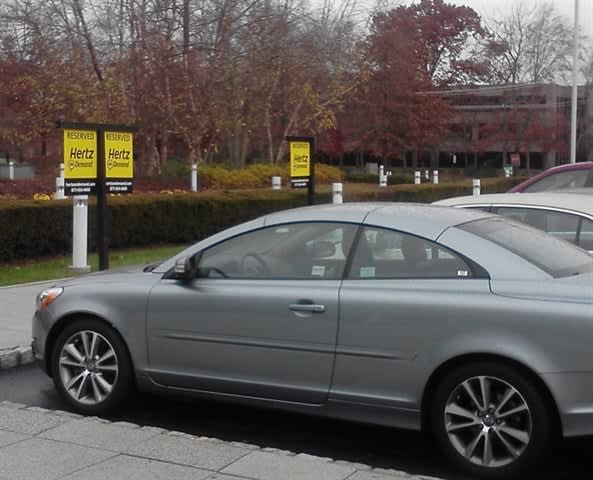
Photo by Adreygrv, Wikimedia Commons
Hertz On Demand vehicles at a Park Ridge, N.J. location. The service, which has no membership fees or annual renewal fees, was formerly known as Connect by Hertz prior to July 2011.
Hammerle says she primarily uses the service when she has a lot of groceries or when she’s going to visit her sister. Instead of taking three or four trains for a three-hour journey to visit her sister, she reserves a Hertz On Demand vehicle to tackle what’s only a 40-minute drive. “If I’m going where the public transportation is just inconvenient, that’s when I will grab a car,” she says.
Without car sharing, Hammerle says it would be difficult to use public transportation, just as it would be difficult for her to use car sharing without public transportation. “I never thought I was going to give up my car, but the frustration made it so easy for me, especially when I knew there was another option,” she says.
Another Zipcar user, Seattle-resident Damien DeOnier, uses the service for a secondary vehicle while his wife takes their car to work every day. DeOnier works from home half the week and takes public transportation when going into the office. DeOnier’s monthly Zipcar cost is usually $100 to $125.
“I was kind of nervous about losing my freedom of not having a vehicle,” he says. But after using Zipcar for two years, that worry is nonexistent. “It helps me lead a more flexible lifestyle, where I don’t have to deal with maintenance, insurance, extra car payments or parking.”
One of DeOnier’s favorite aspects to Zipcar membership is the ability to use it when traveling, such as during a recent trip to Europe and a business trip to Washington, D.C.
In Philadelphia, John Grummere began using PhillyCarShare a short while after selling his car in 2004. Like DeOnier, Grummere’s wife has a vehicle. Grummere is a painter and has an office at home, so he reserves a Honda Element to move his paintings to galleries. He also used a pickup truck when he moved in with his wife and uses a hybrid or a small sedan when driving his daughter around.
Access and Availability
Though general vehicle availability doesn’t seem to be an issue, on weekends and holidays — and for on-campus locations, finals week — access can become strained. “I wish there were more cars available, especially during finals week,” Kimbell says.
King remembers how last-minute her reservations were when she first started. “But now that it’s becoming more popular I have to think about if I want to rent on the weekend — especially the weekend,” she says, admitting that now she is sometimes forced to walk a few more blocks to get a car.
However, Grummere says he often makes last-minute reservations, noting that he has even reserved a car five minutes before he wanted to use it because he has “difficulty planning in advance.”
While the three non-campus users cite Thanksgiving as the most difficult holiday to find a car, they say that as long as they plan ahead, they can usually get a vehicle. They also agree that for trips longer than a couple days they would go through a traditional car rental company instead.[PAGEBREAK]
Late Fees and Parking
Though all users say this happens rarely, returning a vehicle late — and the fee that comes with it — is bound to happen. Depending on the situation, some companies will not charge a late fee if no one has reserved the vehicle immediately following, or if the user is able to extend the reservation. “In the past year, I have only had one instance in which someone booked right after me so I had to hurry up and get home,” DeOnier says.
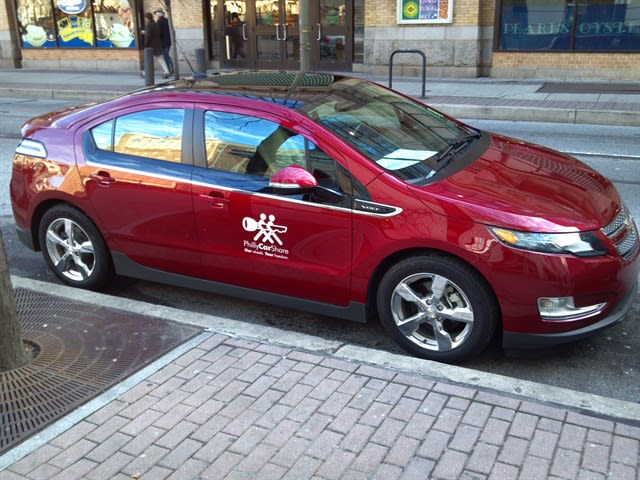
Photo courtesy of PhillyCarShare
A Chevrolet Volt part of the PhillyCarShare fleet on the streets of Philadelphia.
King says she constantly ran into the problem of not reserving enough time when she first started using the service, and so she tends to add an hour cushion on her reservation times. If she gets back early, she will fill up the tank for the next user.
Hertz On Demand users can extend the reservation by turning a dial in the car in five-minute increments, while the next user will get an alert saying that the car is no longer available. “But every time that’s happened, they’ve upgraded me for free to a nicer car, so I really don’t have any complaints about that,” says Hammerle, though she was once switched to a vehicle in New York City, “which was a little inconvenient.” She called customer service and was switched into a closer car immediately.
What happens when you go to your reserved car to find an empty parking space? DeOnier says that when this happened to him, he called Zipcar and the company found the nearest available car and gave him two free hours of driving credit.
Another issue for car-sharing users isn’t with the service itself, but general parking woes from urban dwellers. King says she has had a few incidents in which someone else parked in the dedicated Zipcar space. She says that police are “really good” in ticketing people, but otherwise Zipcar advises you to park in the nearest open spot, which can create confusion for the next user. “It just depends on how good the instructions were from the person before about where they left the car,” she says.
Hammerle has been in about “a half dozen” situations where there was no nearby parking space, so Hertz paid for her to park and then compensated her for a taxi to get home. She says the situation is improving.
Is Vehicle Ownership Off the Table?
Before he got married, Grummere was only using PhillyCarShare, his bicycle and public transit. He found, though, that his demand for a car was getting to be too much, and if his wife didn’t have a vehicle, he probably would’ve needed to buy one. He says if you find yourself using a car-sharing service daily, then the cost might not actually be worth it. “It makes total sense to be used as a secondary car,” he says. “And they (PhillyCarShare) promote it for that purpose anyway.”
Rodriguez hopes to use a car-sharing service after college, but if the option isn’t available, he says he’s glad to have had the opportunity to drive various vehicles before becoming a car owner, including electric vehicles and plug-in hybrids. “After driving an electric car, I’m open to them and understand they are the wave of the future,” he says.
“Economically, I could go out and buy another vehicle right now, but I choose not to because I like the flexibility of driving different vehicles,” DeOnier says. “At this time I would definitely increase my Zipcar use instead of buying another vehicle.”
Hammerle is about to move into a new apartment that includes a parking space. “I’m not even going to buy a car; I’m going to rent my parking spot out and continue to use Hertz On Demand because it’s much more valuable to me,” she says, adding that she can make more money on the parking space than what she pays a month for car sharing.
More Rental Operations
Advantage, Sixt Place Among Top Five in Annual Satisfaction Study
While Enterprise and National retain the top spots in JD Power’s 2026 rankings, the latest customer satisfaction results suggest renters can find competitive service beyond the biggest car rental names.
Read More →
The $100,000 Insurance Trap in Exotic Car Rentals
Exotic rental agencies often rely on customers’ personal auto policies to protect six-figure vehicles. But policy language can dramatically change the coverage for vehicles over $100,000 MSRP.
Read More →
The Booking Is Confirmed, But Is Your Customer Ready to Drive?
For international renters, a confirmed reservation doesn’t always mean they’re eligible to drive. Earlier checks can help operators catch documentation and payment issues before the customer reaches the counter.
Read More →
ICRS 2027 Opens Call for Papers
The International Car Rental Show seeks session proposals on the business, operational, and technology issues facing car rental operators. Submissions are due Jan. 15.
Read More →
Turo to Launch Vehicle Delivery Service
Turo Delivered will let travelers search for vehicles that hosts can deliver directly to hotels, homes, airports, train stations, and other locations.
Read More →
Palm Beach Airport Code Change Creates Car Rental Distribution Gap
A test of rental searches under the old PBI and new DJT airport codes returned largely different sets of brands and vehicles, highlighting a potential distribution problem for rental operators.
Read More →
U-Save Continues Dominican Republic Expansion with Launch in Punta Cana
The new franchise location builds on U-Save’s existing Santo Domingo operation and will begin taking reservations for October 2026.
Read More →
When AI Books the Rental Car, Who Controls the Sale?
As AI moves from comparing rental rates to completing transactions, operators need to understand how travelers find, interpret, rank, and ultimately see their offers. (Part 2 of 2.)
Read More →
European Booked Car Rental Rates Fell 5%, Results Varied by Country
Ireland, Cyprus, and the United Kingdom saw steep declines, while booked rates rose in Poland and Hungary.
Read More →
Is It Time to Rethink Rental Categories?
As traditional economy and compact cars disappear from the market, longtime rental operator Mike DeLorenzo asks whether the industry’s familiar vehicle categories still make sense — and what operators need to rethink along with them.
Read More →