




Shielding Your Company from Employee Fraud
Creating a positive work environment, along with keeping complete and accurate financial records, can help prevent employee fraud.
People don’t like to talk about fraud. They don’t want to admit that someone they trusted stole money.
Businesses fall into two groups: businesses that know they’ve lost money and those that don’t know. You may think I’m being cynical, but I base my view on 30 years of experience working with hundreds of businesses.
For me, there are two red flags indicating fraud. The first is a business owner who operates under the Golden Rule — “He who has the gold makes the rules.”
The second red flag is a business owner who thinks keeping poor records is smart. Poor records cover the fact that he’s under-reporting income.
These signs reflect a poor attitude on the part of the business owners. Owners with poor attitudes tend to have employees with bad attitudes. Employees with bad attitudes tend to be unhappy employees.
Studies indicate that attitude has a lot to do with fraud. Unhappy employees are more likely to commit fraud. Happy employees will be quicker to report dishonest behavior of coworkers. They are your extra eyes in this battle.
Keeping accurate records allows you to detect fraud faster. By looking out for trends, you have a better chance to catch the problem before it becomes too large. However, the bitter truth is that most fraud is discovered by accident.
Before I present some specific examples of fraud, I’d like to talk about people. After all, people commit fraud. Knowing what to look for can make it easier to spot potential problem employees.
Let’s set the stage. You’re helping your longtime friend Frank. Frank says that, although business is going great, there’s no money. Where is the problem? He believes he has a good group of employees. The staff includes three counter agents, a supervisor and a bookkeeper. Some of the employees have been with him for years. Frank says he knows and trusts his employees.
Frank admits he’s taking some money under the table. “You know, a cash deposit here and there. Who’s going to miss it? It is, after all, tax-free money.”
This is your first indication of a problem. If the boss takes money, employees may interpret this attitude as permission to join in. [PAGEBREAK]
John, the senior agent, has not taken a vacation in years. He needs money and doesn’t like vacations. Could he be a problem? Yes. He could have committed fraud and cannot leave for fear of someone finding out.
Peter, a counter agent, has come into an inheritance. He has money and likes having a good time. He dresses sharply, drives a nice car, and treats people to lunch every now and then. Could this be Frank’s problem? Perhaps the inheritance he’s spending has come from the agency.
Sally, another counter agent, is nice, a hard worker, and good with customers. But she has trouble completing paperwork. The only real criticism is that she tends to be absent on Mondays. Could there be a problem here? Not getting paperwork done properly could point to the possibility of fraud. Her absence on Mondays could be a sign of a possible drug or drinking problem.
Jim, the manager, is a real problem. His job is to review the operation and see that people do things properly. He doesn’t have time for paperwork. He argues against controls and is adamant that putting more controls in place will not solve problems. He feels that more effort should be made in keeping customers happy. He doesn’t see the value of spending time accounting for the contracts and balancing the reports on a daily basis.
Are these concerns reasonable, or is Jim hiding something?
Finally, there’s Jane. Jane, the bookkeeper, has been with the business since the start. Everyone feels for Jane. Her husband has cancer and the medical bills are piling up. They don’t have insurance, but somehow she finds the money to keep up the treatments for her husband. Could this be the source of Frank’s problem? Keep in mind that people under financial pressure and emotional stress are capable of doing things that they would normally never do.
After spending a couple of days getting to know the people and the business, what do you do now? While Frank believes that his employees are honest, you’ve seen potential problems everywhere you’ve looked. When you face a problem like this, follow this precept: Believe nothing, trust no one, and take nothing for granted.
Good records minimize exposure to fraud. The easiest thing to steal is money. Number one rule: Follow the money trail. Is a hand-based system or a computer-based system in place? Hand-based systems are easier to cheat than computer-based systems. If the system is computer-based, are employees using it according to instructions? Are the people taking shortcuts?
Document all procedures used. Is there a weakness? Think like a thief. How would you take money out? Again, follow the money trail.
Let me give you an example. At an agency that didn’t use a computer, I was suspicious of the daily reports. The reports were done by hand. As a cross-check, I had the daily reports entered into a spreadsheet. Sure enough, there was a consistent pattern of errors. The columns showed that more money was collected than was reported. If you examined each line, it was correct. When you totaled the lines, there was a shortage. This was one method by which money was taken out of the business.
In another case, I saw that some cars went out with the notation “VISA.” This meant that a credit card deposit was taken rather than a cash deposit. I tracked down the rental agreements. I found that some of them indicated cash while the daily report indicated “VISA.” This technique, employed two or three times a week, resulted in the owners losing about a $1,000 per week.
How did I know where to look? I had no idea when I started. I just followed the money and took nothing for granted. Where records were missing, I reconstructed them. You don’t need an accounting background to do what I did. What you need is a little patience, an inquisitive mind, and a little time to uncover these things.
Henry Wort is a certified public accountant with more than 30 years of experience. He has conducted a number of fraud audits for small businesses, including car rental companies. He is now preparing to open his own car rental agency in Vista, Calif.
More Rental Operations

Palm Beach Airport Code Change Creates Car Rental Distribution Gap
A test of rental searches under the old PBI and new DJT airport codes returned largely different sets of brands and vehicles, highlighting a potential distribution problem for rental operators.
Read More →
U-Save Continues Dominican Republic Expansion with Launch in Punta Cana
The new franchise location builds on U-Save’s existing Santo Domingo operation and will begin taking reservations for October 2026.
Read More →
When AI Books the Rental Car, Who Controls the Sale?
As AI moves from comparing rental rates to completing transactions, operators need to understand how travelers find, interpret, rank, and ultimately see their offers. (Part 2 of 2.)
Read More →
European Booked Car Rental Rates Fell 5%, Results Varied by Country
Ireland, Cyprus, and the United Kingdom saw steep declines, while booked rates rose in Poland and Hungary.
Read More →
Is It Time to Rethink Rental Categories?
As traditional economy and compact cars disappear from the market, longtime rental operator Mike DeLorenzo asks whether the industry’s familiar vehicle categories still make sense — and what operators need to rethink along with them.
Read More →
Who Owns the Rate? AI Is Creating a New Distribution Problem for Car Rental
Generative Engine Optimization asks whether AI can find a rental company, but operators also need to know whether the agent inspected enough of the market, compared equivalent offers, and presented a rate the traveler can actually book. (Part 1 of 2)
Read More →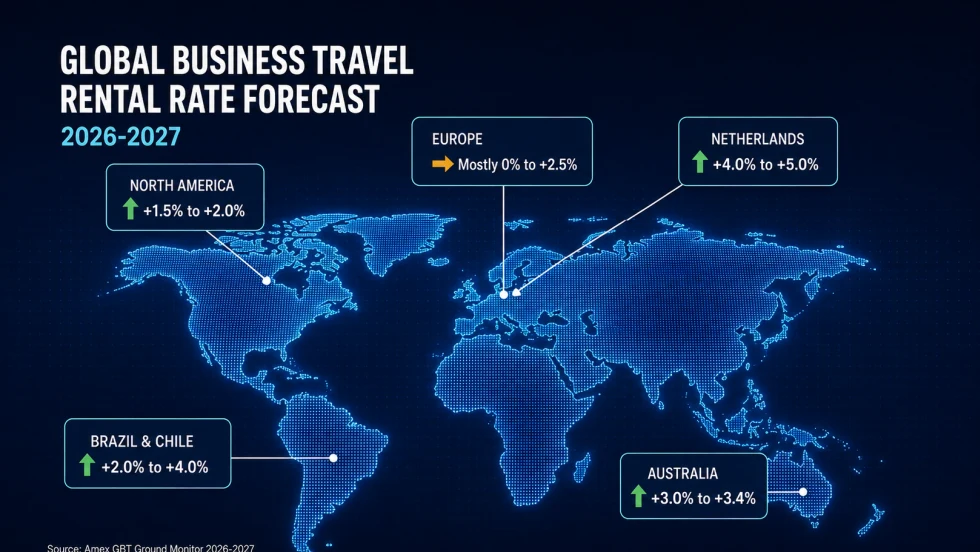
U.S. Business Travel Car Rental Rates Forecast to Rise Up to 2%
Improved fleet supply should limit pricing gains in 2026-27, while insurance, repair costs, and softer residual values continue to pressure rental operations, according to Amex GBT.
Read More →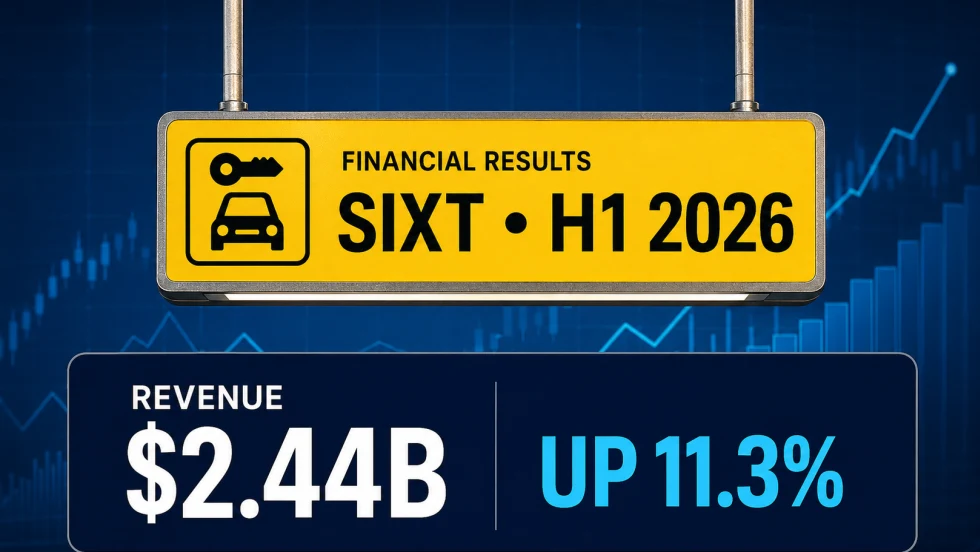
Sixt Revenue Tops $2.4 Billion in First Half of 2026
Sixt’s first-half revenue surpassed $2.4 billion for the first time as demand outpaced fleet growth, lifting utilization and earnings despite weaker consumer sentiment in North America.
Read More →
In Memoriam: Bobby Klyce, Avis Licensee Legend
The longtime Birmingham Avis operator and 2018 Auto Rental News Impact Award recipient was remembered as an advocate for independent licensees and the broader car rental industry.
Read More →
How to Build Custom Fleet Tools With AI and Vibe Coding [Webinar]
A new Automotive Fleet webinar explores how fleet managers are using AI and vibe coding to automate routine work and create simple operational tools without traditional programming skills.
Read More →