




Technology and the Path Around Resistance
How do you deal with resistance? First, let's define resistance. In high school physics, resistance was something that blocked the flow of electricity. In World War II, resistance was a group of people who tried to block the onslaught of totalitarianism.
How do you deal with resistance? First, let's define resistance. In high school physics, resistance was something that blocked the flow of electricity. In World War II, resistance was a group of people who tried to block the onslaught of totalitarianism. You might be wondering what resistance has to do with the car rental industry. Well, like in anything worthwhile, how we deal with resistance and get around it are keys to being effective and successful.
Technology is one of the ways we get around resistance. As car rental organizations have increased in size and complexity, the computer has played its part in helping to deal with the complexity and provide competitive advantage. The computer has also had its part in adding to the complexity. So, one of the keys to dealing with resistance is to know when, how and to what degree to apply technology. Technologists need to provide the most cost-effective solution that solves the problem and deals with the resistance.
Let's face it, we all want more reservations and more rentals. Simple, succinct and to the point. How we go about achieving this goal is different for each of us. One thing that's important is preserving past investments. Sure, there are lots of great new technologies out there, but money spent over and over again to solve the same problem or address the same opportunity is a waste. Build a good foundation the first time and you can build on top of it for a long time.
Sometimes, even with a good foundation, we muck it up over the years. If your house is like mine, rational decisions of the past, like drilling holes for pipes and running electrical lines, etc., can affect new opportunities for improvement -- some of that previously mentioned resistance. This is no different than what happens with car rental systems.
Isaac Newton said it best: "For every action there is an equal and opposite reaction." That's the nature of a competitive business. Companies must react or adapt to change. It makes no sense to always build a new foundation. The key is to build on what you have. In my world, it's called a Services-Oriented Architecture (SOA).
The best way for all of us to understand SOA is by using an example -- a restaurant. Certainly a restaurant is "service oriented." One of my favorites is a certain Italian restaurant in New York City. I look at the menu and see Veal Saltimbocca. Over to the right are the swinging doors into the kitchen. Those swinging doors hide the complexity of preparing not only the Veal Saltimbocca but all the food for all the customers. Waiters run in and out of the doors. They see the complexity -- and possibly the inefficiencies of the kitchen -- and deal with it to bring the customers their meals.
The waiters act as a façade. The customers use a repeatable service called ordering. All waiters use the same format and work off the same menu. They are an "abstraction layer"; they handle the interface with the complex processing behind the swinging doors.
So how is a reservation and rental system like a restaurant? Just like the kitchen, lots of excellent work is done there, much of it is already paid for, and sometimes changing the menu causes the owner to have to change the "plumbing."
From the customers' perspective, they receive a service without worrying about anything but the interface with the waiter. One of the biggest benefits of this approach is the ability to repeat and reuse it, regardless of whether it's a chain of restaurants or multiple channels for creating reservations and rentals.
The approach I use as the framework for moving to a services-oriented architecture is based on four principles:
• Selective renovation of the "kitchen"
• Build on standards
• Create a menu of reusable services that provide business flexibility
• Minimize cost.
Selective renovation of the "kitchen" means that refinements will be made to our core system to allow for added flexibility and to realize cost efficiencies. Successful delivery of an SOA depends on using standards and specifications.
The OpenTravel Alliance (OTA) provides a set of XML specifications for each travel supplier vertical. Leveraging this specification along with Simple Object Access Protocol (SOAP) offers an accepted and mature method for SOA implementation.
Other standards, such as WS-Security and http, complete a minimum set of standards that should survive the years ahead. Architectures must be designed to accommodate new and maturing standards such as SAML, UDDI and WSDL. The services created need the right level of "abstraction."
Services that are too specific (fine grained) are not reusable. Services that are too general (coarse grained), however, may provide no benefit. Perhaps Goldilocks said it best: We want our services "just right." When services are just right, they’re more likely to be reused with little effort. Lastly, SOAs do require some investment but need to save money over time.
The migration to SOA gains more acceptance from year to year. Organizations like the OTA have been created to facilitate adoption. The idea behind SOA is to deal with resistance. In the field of electricity, the symbol for resistance is the Greek letter for Omega. Omega can also be defined as the end of a journey. At Cendant Car Rental Group we have converged our SOA initiatives into one juggernaut for the future, which I call OMEGA (One Merged Enterprise and Global Architecture). We're on the road to our OMEGA. Are you?
John Turato is vice president of technology for Cendant Car Rental Group.
More Rental Operations

ICRS 2027 Opens Call for Papers
The International Car Rental Show seeks session proposals on the business, operational, and technology issues facing car rental operators. Submissions are due Jan. 15.
Read More →
Turo to Launch Vehicle Delivery Service
Turo Delivered will let travelers search for vehicles that hosts can deliver directly to hotels, homes, airports, train stations, and other locations.
Read More →
Palm Beach Airport Code Change Creates Car Rental Distribution Gap
A test of rental searches under the old PBI and new DJT airport codes returned largely different sets of brands and vehicles, highlighting a potential distribution problem for rental operators.
Read More →
U-Save Continues Dominican Republic Expansion with Launch in Punta Cana
The new franchise location builds on U-Save’s existing Santo Domingo operation and will begin taking reservations for October 2026.
Read More →
When AI Books the Rental Car, Who Controls the Sale?
As AI moves from comparing rental rates to completing transactions, operators need to understand how travelers find, interpret, rank, and ultimately see their offers. (Part 2 of 2.)
Read More →
European Booked Car Rental Rates Fell 5%, Results Varied by Country
Ireland, Cyprus, and the United Kingdom saw steep declines, while booked rates rose in Poland and Hungary.
Read More →
Is It Time to Rethink Rental Categories?
As traditional economy and compact cars disappear from the market, longtime rental operator Mike DeLorenzo asks whether the industry’s familiar vehicle categories still make sense — and what operators need to rethink along with them.
Read More →
Who Owns the Rate? AI Is Creating a New Distribution Problem for Car Rental
Generative Engine Optimization asks whether AI can find a rental company, but operators also need to know whether the agent inspected enough of the market, compared equivalent offers, and presented a rate the traveler can actually book. (Part 1 of 2)
Read More →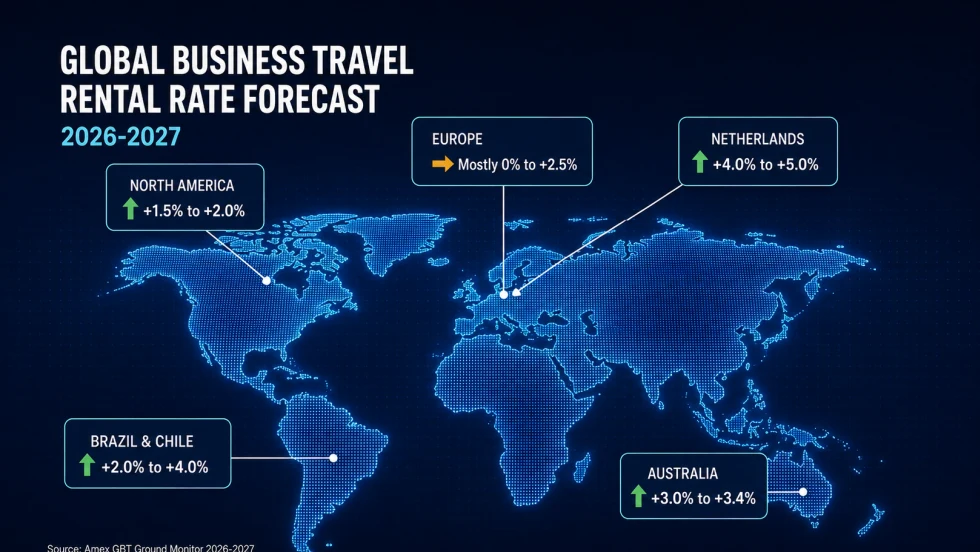
U.S. Business Travel Car Rental Rates Forecast to Rise Up to 2%
Improved fleet supply should limit pricing gains in 2026-27, while insurance, repair costs, and softer residual values continue to pressure rental operations, according to Amex GBT.
Read More →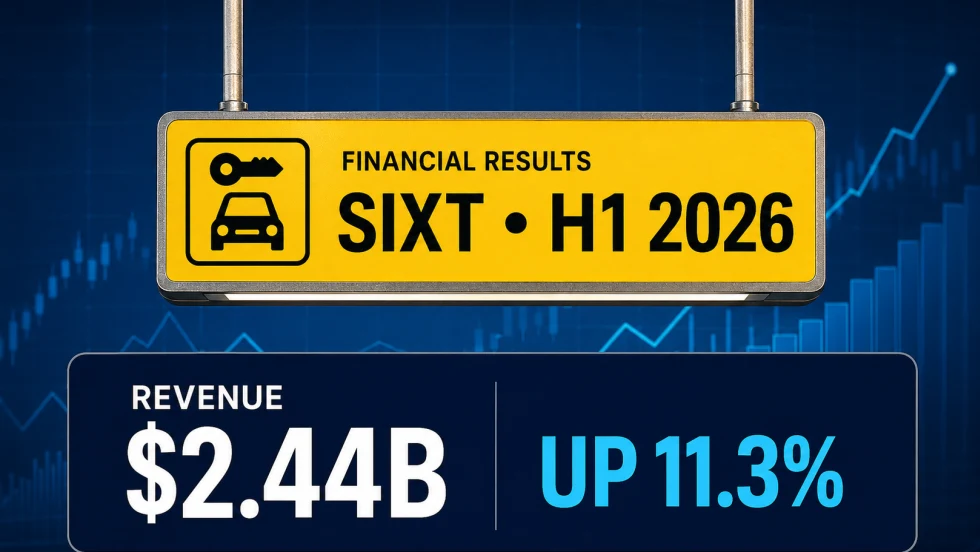
Sixt Revenue Tops $2.4 Billion in First Half of 2026
Sixt’s first-half revenue surpassed $2.4 billion for the first time as demand outpaced fleet growth, lifting utilization and earnings despite weaker consumer sentiment in North America.
Read More →