




U.S. Business Travel Car Rental Rates Forecast to Rise Up to 2%
Which Is Cheaper, Ride-Hailing or Car Rental?
An Amex GBT comparison of airport trips in 10 U.S. cities found that rental was the clear winner for some one-day trips. But trip length, parking, fuel, and the number of local journeys can change the calculation.
August 30, 2026

The best comparison isn't daily rate versus single fares, but the total cost of an itinerary.
Credit:
Auto Rental News
4 min to read
Is it cheaper to rent a car or use ride-hailing after arriving at the airport? An analysis from American Express Global Business Travel found there is no universal answer.
Amex GBT compared the cost of an airport-to-city-center round trip in 10 major U.S. business travel markets. The analysis considered average daily rental rates, ride-hail fares, tolls and parking charges.
For a one-day trip, car rental was clearly less expensive than ride-hailing in five of the 10 cities studied: Chicago, Detroit, Los Angeles, Phoenix and San Francisco.
In four other markets — Atlanta, Dallas, Houston and New York — the listed rental price was lower than the ride-hail fare, but Amex GBT classified the comparison as borderline because adding fuel could eliminate the rental advantage.
Charlotte was the only market in which the listed one-day rental cost was already higher than the ride-hail round trip before accounting for fuel.
One-Day Rental Costs Varied by Market
The largest apparent one-day rental advantage occurred in San Francisco. Amex GBT calculated a $75.27 one-day rental cost for a trip between San Francisco International Airport and the Transamerica Pyramid, compared with $126.86 for ride-hailing.
In Los Angeles, the comparison was $93 for a one-day rental versus $124.90 for a ride-hail round trip between Los Angeles International Airport and the Museum of Contemporary Art.
Other comparisons in which rental had a clear advantage included:
- Chicago: $67.49 for rental versus $92.89 for ride-hailing.
- Detroit: $72 for rental versus $110.39 for ride-hailing.
- Phoenix: $60.88 for rental versus $87.87 for ride-hailing.
The Dallas comparison was nearly even: $62.88 for a one-day rental versus $62.91 for ride-hailing. Any fuel expense would make ride-hailing the less expensive option in that scenario.
In Charlotte, ride-hailing cost $49.86 for the round trip, compared with $63.15 for a one-day rental.
Two-Day Trips Shifted the Advantage to Ride-Hailing
The result changed when the rental extended into a second day.
In the scenario modeled by Amex GBT, ride-hailing was less expensive in all 10 cities when the traveler kept the rental vehicle for two days but needed only an airport-to-city trip and the return journey.
The reason is straightforward: The ride-hail customer paid for two individual trips, while the renter accumulated a second day of rental charges along with potential parking and fuel expenses.
In New York, for example, the report estimated a $168.72 ride-hail round trip between LaGuardia Airport and the New York Stock Exchange. The estimated rental cost was $150 for one day and $286.50 for two days.
In San Francisco, the $75.27 one-day rental increased to $150.54 over two days, exceeding the $126.86 ride-hail round trip.
More Local Trips Can Favor Car Rental
The comparison changes again when the traveler needs transportation beyond the two airport transfers.
A traveler making several journeys during the day would incur a separate ride-hail fare for each trip. The rental rate, by contrast, gives the customer continuous access to a vehicle throughout the rental period.
Amex GBT concluded that rental becomes more cost-effective as the number of local journeys increases. Avoiding parking charges can further strengthen the case for renting.
The analysis also does not capture differences in convenience, wait times, vehicle availability, route flexibility or the ability to carry luggage and equipment. Those considerations may influence a traveler’s decision even when one option has a modest price advantage.
For rental operators, the findings show that car rental’s business travel value proposition is strongest when customers require multiple trips, flexibility or continuous vehicle access, not simply transportation from the airport and back.
The comparison was conducted during the fourth quarter of 2025 and was intended as an illustrative snapshot. Amex GBT cautioned that the figures should not be treated as currently bookable rates.
Our Take — Break it Down for the Customer
Auto Rental News has been having this debate since Uber and Lyft became viable transportation options in 2010. Back then and today, we still need to concentrate not on a daily rate versus a single fare, but the total cost of an itinerary.
Rental companies have an opportunity to make their value easier to recognize. How about an app in which a customer can enter the length of stay, expected mileage, and number of planned stops, and see an estimated break-even point between renting and buying rides individually. Adding realistic fuel, parking, and ancillary charges would make the comparison more credible, not less favorable.
Rental has traditionally been marketed as a product with a daily price when it should be presented as an itinerary-based mobility option. The company that helps travelers understand the full cost before they choose may have a greater advantage than the company displaying the lowest initial rate.
Subscribe to Our Newsletter
More Articles
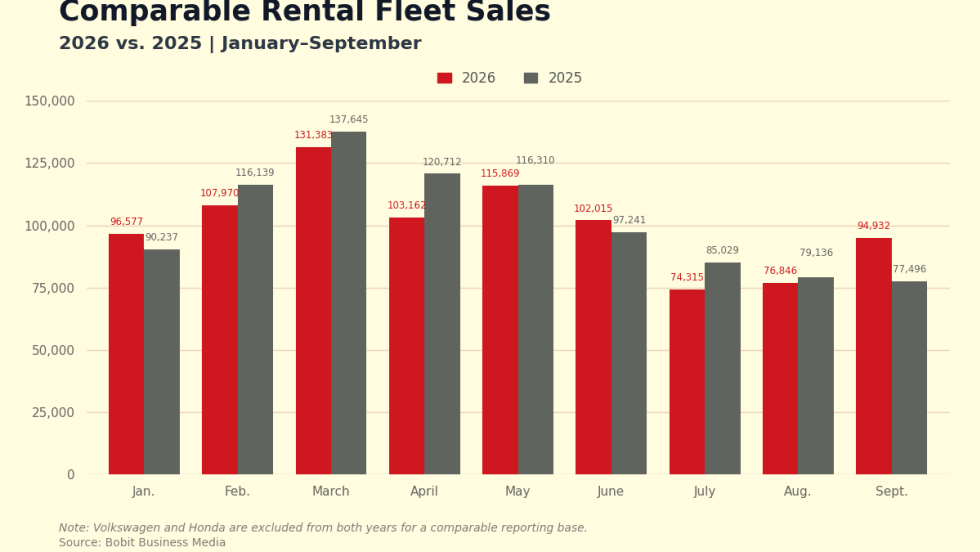
September Rental Fleet Sales Jump 22.5%, Narrowing Year-to-Date Decline
Comparable rental fleet sales remained 1.8% below 2025 through September, as a stronger month cut the year-to-date shortfall by more than half.
Read More →
Advantage, Sixt Place Among Top Five in Annual Satisfaction Study
While Enterprise and National retain the top spots in JD Power’s 2026 rankings, the latest customer satisfaction results suggest renters can find competitive service beyond the biggest car rental names.
Read More →
ACRA 2026 Annual DC Industry & Policy Conference in Photos
Car rental made its voice heard on Capitol Hill Sept. 22-25.
Read More →
The $100,000 Insurance Trap in Exotic Car Rentals
Exotic rental agencies often rely on customers’ personal auto policies to protect six-figure vehicles. But policy language can dramatically change the coverage for vehicles over $100,000 MSRP.
Read More →
How Operators Will Work With Their RMS in the Age of AI
AI embedded directly into rental management systems could change how operators analyze their businesses and take action, while raising new questions about permissions and control.
Read More →
The Booking Is Confirmed, But Is Your Customer Ready to Drive?
For international renters, a confirmed reservation doesn’t always mean they’re eligible to drive. Earlier checks can help operators catch documentation and payment issues before the customer reaches the counter.
Read More →
What Happens During a “Day on the Hill?”
Walking into a congressional office to discuss legislation certainly is outside the normal workday for most of us. But it’s a worthy, fun, and meaningful experience.
Read More →
ICRS 2027 Opens Call for Papers
The International Car Rental Show seeks session proposals on the business, operational, and technology issues facing car rental operators. Submissions are due Jan. 15.
Read More →
Turo to Launch Vehicle Delivery Service
Turo Delivered will let travelers search for vehicles that hosts can deliver directly to hotels, homes, airports, train stations, and other locations.
Read More →
Palm Beach Airport Code Change Creates Car Rental Distribution Gap
A test of rental searches under the old PBI and new DJT airport codes returned largely different sets of brands and vehicles, highlighting a potential distribution problem for rental operators.
Read More →