




Airline Surcharges Make Up for Loss in Business Travel Revenue
Passenger demand is increasing, but airlines aren’t adding any capacity. Non-ticket revenue, such as checked-on baggage fees and charging customers for changing their reservations, is helping.
Fuel surcharges that are typically added on to international airfares are likely to climb along with average base-level fares to help offset the higher expense of rising jet fuel prices, said Hotwire's Chief Executive Clem Bason.
Bason was quoted in a Marketwire article as saying that passenger demand is increasing, but airlines are not adding any capacity.
As the price of jet fuel hit a record high in 2008, airlines in many cases scaled back the frequency of flights, but they also parked older jets that were less fuel efficient and more expensive to maintain.
British Airways raised its surcharge recently, and U.S. airlines are likely to do the same.
Such surcharges can add on an additional $300 to $400 to a ticket, and are generally added as the industry moves into the peak travel period.
Average airfare for international flights this summer is already up 23 percent from a year ago and is climbing further as planes fill up, according to Hotwire.com. Domestic airfare is up 15 percent.
United Airlines' parent company UAL Corp. said its April passenger-unit revenue increased an estimated 23 to 24 percent from a year ago. Non-ticket revenue, such as checked-on baggage fees and charging customers for changing their reservations, helped that increase. Non-ticket revenue accounted for 2.6 percentage points of April's unit-revenue growth.
Though corporate travel offices have increased their travel budgets, they are nowhere near 2008 peaks, and may not be for some time. To offset the loss of business customers, airlines have been focusing on non-ticket revenue, or ancillary revenue, which includes all the little charges that drive most customers crazy, but are credited by airlines for keeping airfare competitive.
Most business travelers are exempt from extra fees such as checked-on luggage and premium economy-class seating, where as leisure travelers could easily pay an extra $100 on top of their airfare for each round trip.
During the fourth quarter, ancillary fees rose 18.3 percent from a year ago to $7.8 billion, and constituted 6.5 percent of the total revenue for 32 reporting carriers, according to the U.S. Bureau of Transportation Statistics.
More Rental Operations
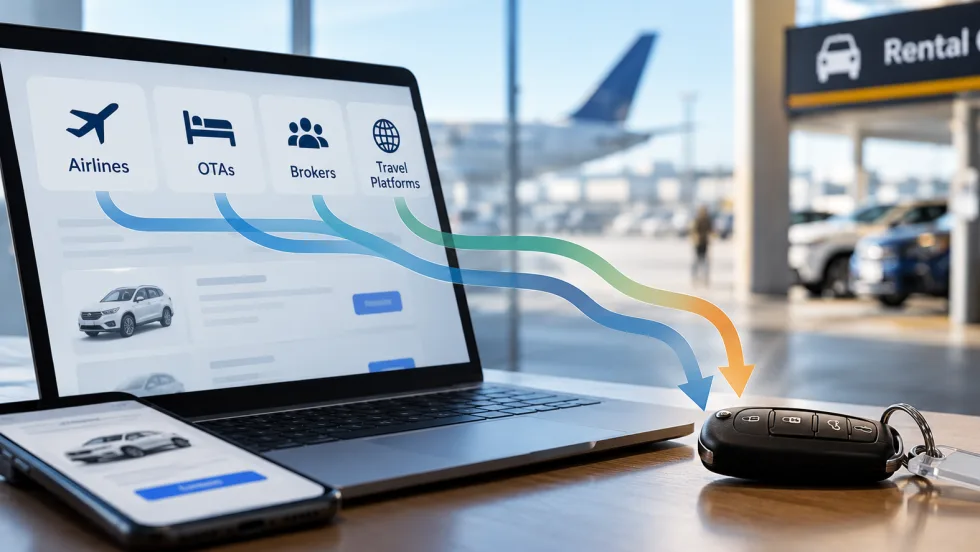
Direct, Broker or Hybrid? How Travel Retailers Source Rental Cars
As travel retailers weigh direct supplier relationships against third-party distribution, rental operators need to understand how those decisions affect their business.
Read More →
How Did This Independent Rental Operator Grow to 170 Vehicles in 4 Years?
With 170 vehicles across three Kentucky locations, Joel Price relies on an overseas team to handle reservations, payments, and after-hours customer service. It's one part of an unconventional approach to growing an independent rental operation.
Read More →
What Does It Take to Succeed in B2B Rentals?
The fundamentals may be familiar to daily car rental operators, but project-based truck rentals put different demands on the fleet and the business.
Read More →
NPR Builds on International Partnerships to Grow Rental Bookings
With Ana Laborde supporting broker development, NPR Auto Group is tailoring distribution strategies, rate packages, and partnerships to grow international reservations across its three brands.
Read More →
Advantage, Sixt Place Among Top Five in Annual Satisfaction Study
While Enterprise and National retain the top spots in JD Power’s 2026 rankings, the latest customer satisfaction results suggest renters can find competitive service beyond the biggest car rental names.
Read More →
The $100,000 Insurance Trap in Exotic Car Rentals
Exotic rental agencies often rely on customers’ personal auto policies to protect six-figure vehicles. But policy language can dramatically change the coverage for vehicles over $100,000 MSRP.
Read More →
The Booking Is Confirmed, But Is Your Customer Ready to Drive?
For international renters, a confirmed reservation doesn’t always mean they’re eligible to drive. Earlier checks can help operators catch documentation and payment issues before the customer reaches the counter.
Read More →
ICRS 2027 Opens Call for Papers
The International Car Rental Show seeks session proposals on the business, operational, and technology issues facing car rental operators. Submissions are due Jan. 15.
Read More →
Turo to Launch Vehicle Delivery Service
Turo Delivered will let travelers search for vehicles that hosts can deliver directly to hotels, homes, airports, train stations, and other locations.
Read More →
Palm Beach Airport Code Change Creates Car Rental Distribution Gap
A test of rental searches under the old PBI and new DJT airport codes returned largely different sets of brands and vehicles, highlighting a potential distribution problem for rental operators.
Read More →