




ALG Releases OEM Rental Fleet Penetration Statistics
High rental fleet penetration has been found to negatively impact residual value performance and perception of quality, according to Automotive Lease Guide.
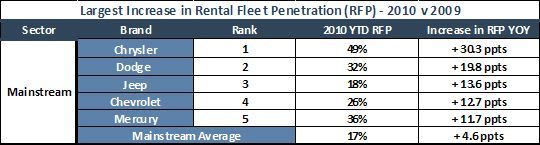
Rental fleet penetration (RFP), which Automotive Lease Guide measures as the total number of vehicles sold into rental fleet channels divided by total sales, has been found to have an impact on both residual performance and perception of quality.
Economic recovery has helped boost total sales for the overall industry with an approximately 31 percent year-over-year increase in total sales from 2010 to 2009 (July year to date). RFP for the industry has similarly increased from an approximately 11 percent in 2009 year to date an approximately 13 percent in 2010 year to date, resulting in an increase to ALG's used supply forecast.
The two tables below illustrate the year-over-year changes in rental fleet penetration from 2010 compared to 2009 (average through July year to date) for mainstream and luxury brands. As a general rule, ALG recommends RFP levels below 10 percent for mainstream brands and less than 5 percent for luxury brands to avoid any negative impact from rental fleet sales on residual performance.
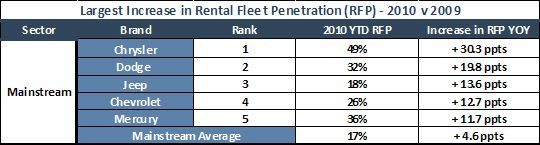
Mainstream Brands
The Chrysler brand, which has had a history of high rental fleet levels in the past several years, showed the highest increase in RFP to an approximately 49 percent in 2010 year to date compared to an approximately 19 percent in 2009 year to date. Dodge and Jeep, also operating under the Chrysler umbrella, showed high year-over-year increases in RFP with levels at 32 percent and 18 percent for 2010 year to date, respectively. Though industry retail sales showed improvement in 2010 year to date, the Chrysler, Dodge and Jeep brands all suffered declines in retail sales compared to 2009 year to date. While the decline in sales has a positive impact on residual values due to the drop in used supply, the increase in rental fleet penetration will negate much of the used supply impact on residual values due to the decline in perceived quality and residual performance relative to the competitors.
Chevrolet also displayed high increases in RFP levels to an approximately 26 percent for 2010 year to date compared to an approximately 13 percent in 2009 year to date. Retail sales for the Chevrolet brand also increased, resulting in increased used supply for the brand which would negatively impact residual performance, holding all else constant. Mercury rounded out the mainstream brands that experienced the largest increases in RFP levels.
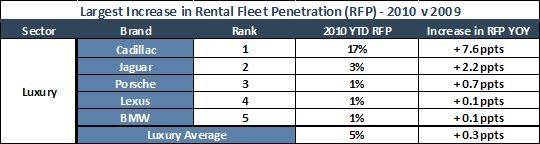
Luxury Brands
ALG has found that rental fleet sales have an even more detrimental effect on residual values and perceived quality for luxury brands compared to mainstream brands. Cadillac showed the highest year-over-year increase in RFP from an approximately 9 percent in 2009 year to date to an approximately 17 percent for 2010 year to date. Though rental fleet sales showed a significant increase compared to the Luxury brand average, Cadillac has shown improvements in other metrics. Retail sales grew by 34 percent in 2010 compared to 2009 (July year to date), while incentives decreased. While this is a positive story for Cadillac, the increase in rental fleet penetration will place the brand at a disadvantage compared to other luxury brands that have kept rental fleet below the 5 percent mark.
The other brands in the luxury list all had fairly small changes to RFP levels and averaged less than 5 percent for both 2009 and 2010 year to date. Both the mainstream and luxury domestic brands have shown higher rental fleet trends versus their import counterparts.
More Rental Operations
Direct, Broker or Hybrid? How Travel Retailers Source Rental Cars
As travel retailers weigh direct supplier relationships against third-party distribution, rental operators need to understand how those decisions affect their business.
Read More →
How Did This Independent Rental Operator Grow to 170 Vehicles in 4 Years?
With 170 vehicles across three Kentucky locations, Joel Price relies on an overseas team to handle reservations, payments, and after-hours customer service. It's one part of an unconventional approach to growing an independent rental operation.
Read More →
What Does It Take to Succeed in B2B Rentals?
The fundamentals may be familiar to daily car rental operators, but project-based truck rentals put different demands on the fleet and the business.
Read More →
NPR Builds on International Partnerships to Grow Rental Bookings
With Ana Laborde supporting broker development, NPR Auto Group is tailoring distribution strategies, rate packages, and partnerships to grow international reservations across its three brands.
Read More →
Advantage, Sixt Place Among Top Five in Annual Satisfaction Study
While Enterprise and National retain the top spots in JD Power’s 2026 rankings, the latest customer satisfaction results suggest renters can find competitive service beyond the biggest car rental names.
Read More →
The $100,000 Insurance Trap in Exotic Car Rentals
Exotic rental agencies often rely on customers’ personal auto policies to protect six-figure vehicles. But policy language can dramatically change the coverage for vehicles over $100,000 MSRP.
Read More →
The Booking Is Confirmed, But Is Your Customer Ready to Drive?
For international renters, a confirmed reservation doesn’t always mean they’re eligible to drive. Earlier checks can help operators catch documentation and payment issues before the customer reaches the counter.
Read More →
ICRS 2027 Opens Call for Papers
The International Car Rental Show seeks session proposals on the business, operational, and technology issues facing car rental operators. Submissions are due Jan. 15.
Read More →
Turo to Launch Vehicle Delivery Service
Turo Delivered will let travelers search for vehicles that hosts can deliver directly to hotels, homes, airports, train stations, and other locations.
Read More →
Palm Beach Airport Code Change Creates Car Rental Distribution Gap
A test of rental searches under the old PBI and new DJT airport codes returned largely different sets of brands and vehicles, highlighting a potential distribution problem for rental operators.
Read More →