




Business Travel Growth in Western Europe Expected to Improve, GBTA Forecasts
While challenges remain for the Southern Europe economies, the Global Business Travel Association (GBTA) forecasts that business travel will increase within Germany and the UK, particularly domestic business travel spend.
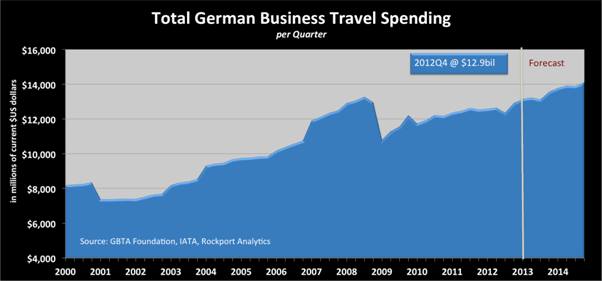
The Global Business Travel Association (GBTA) released April 4 its latest GBTA BTI Outlook report on Western Europe as part of its semi-annual series.
“In the context of the struggling European economy, our expectations for business travel spending in Western Europe are relatively positive for 2013,” said Catherine McGavock, GBTA’s regional director for Europe. “There are signs of recovery in Germany and the UK, with both expected to experience growth in business travel spending this year. We believe that this is the beginning of a wider trend in the region and expect growth in business travel spending to accelerate in 2014 to the levels we saw before the Eurozone crisis.”
According to Tad Fordyce, head of Global Commercial Solutions, Visa Inc., the World Travel and Tourism Council estimates that the travel industry contributed 9% of global GDP and more than $6 trillion in 2012. “As more businesses around the world return to travel for work, it will only bode well for helping to improve that global economic outlook,” he said.
Challenges Remain
GBTA forecasts an improvement in business travel spending growth throughout 2013 across most of developed Europe. Germany, in particular, is set to remain one of the leading economies, with both its economy and business travel market expected to achieve the highest levels of growth in the region. German business travel spending is forecast to expand by 5% over 2013. The UK will also undergo some improvements with 1.9% growth in business travel spend in 2013.
The southern economies of Spain and Italy however continue to experience a challenging recovery. Total business travel spending is expected to experience a significant fall, with Spain and Italy recording negative growth rates of -6.2% and -2.9%, respectively. This decline is having a domino effect on other European countries. France’s exposure to these southern economies, combined with structural economic issues, is set to cause a weakening of -1.4% in business travel spend in 2013.
The report shows that a key factor in the performance of a country’s overall business travel spending in 2013 is domestic travel. Its importance is illustrated by the fact that those countries forecast to experience positive growth in total business travel spending are also expected to have strong domestic business travel growth. Spending on domestic travel in Germany, for example, is set to grow by 5.7%, while its international outbound spending growth will be 2%. The significance of domestic business travel is partly due to the impact that reduced trade will have on international outbound travel in 2013.
2014: The Importance of Outbound Travel
In 2014, GBTA forecasts a return to an improved and stable environment for business travel in Western Europe, with the five most critical business travel markets — Germany, the UK, France, Italy and Spain — returning to growth.
A key factor of this recovery is international outbound travel, with all countries achieving positive growth in the sector as trade prospects improve. It will be the southern economies in particular that will experience the highest level of growth in international outbound travel. Overall GBTA expects total business travel spending among the five countries to hit $184 billion in 2014.
Country-Level Business Travel Outlooks
Germany
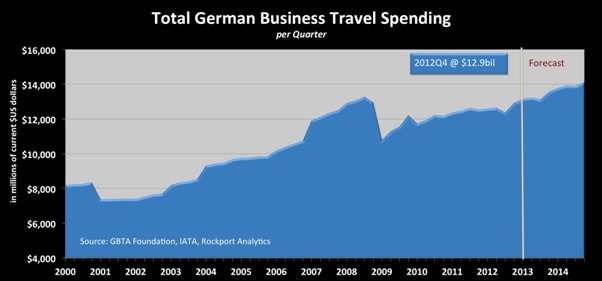
GBTA forecasts German business travel spending to grow by 5% in 2013 to $53 billion and it is expected to grow an additional 5% in 2014 to $55.7 billion.
Domestic travel spending will grow an estimated 5.7% in 2013, followed by an additional 6% in 2014.
GBTA predicts international outbound business travel to bounce back to 2% in 2013 and another 0.6% in 2014.
United Kingdom
GBTA forecasts that business travel spending will pick up pace in 2013, expanding 1.9% to $41 billion.
Domestic business travel will outperform international outbound travel in 2013.
Growth in both domestic and international outbound travel spending will accelerate in 2014, with international outbound growth doubling to 3% reaching $13.7 billion and domestic travel will grow at a rate of 4.4% to $28.3 billion.
France
GBTA expects that business travel in France will continue to slow in the short-run, with spending forecast to fall by -1.4% to $35.2 billion in 2013.
As the economies of two of France’s key trading partners, Italy and Spain, continue to weaken in 2013, international outbound travel will drop by -4.6%, while domestic travel remains relatively flat at 0.5%.
GBTA forecast a positive outlook for 2014, with international outbound growing by 3.3% to $13 billion and domestic travel spending growing 5.4% to $23.8 billion.
Spain
Recovery in Spain continues to be elusive, which is reflected by the forecast of a decline of -6.2% in business travel spending in 2013.
Both domestic and international outbound business travel will decline in 2013, falling -5.4% and -9.4%, respectively.
Growth in 2014 will mainly be driven by domestic business travel, which is projected to grow by 2.2%, while international outbound travel will remain flat in 2014.
Italy
GBTA’s forecast for 2013 has been significantly downgraded due to prolonged economic uncertainty, and it is expected that total business travel spend will fall by -2.9% in 2013.
Spending on both domestic and international outbound travel will fall in 2013 by -2.8% and -3.8%, respectively.
In the context of decreasing borrowing costs and lower budget deficits, GBTA forecasts growth of 1.4% in domestic travel spending and a rise of 1.9% in international outbound travel spending in 2014.
More Rental Operations

Advantage, Sixt Place Among Top Five in Annual Satisfaction Study
While Enterprise and National retain the top spots in JD Power’s 2026 rankings, the latest customer satisfaction results suggest renters can find competitive service beyond the biggest car rental names.
Read More →
The $100,000 Insurance Trap in Exotic Car Rentals
Exotic rental agencies often rely on customers’ personal auto policies to protect six-figure vehicles. But policy language can dramatically change the coverage for vehicles over $100,000 MSRP.
Read More →
The Booking Is Confirmed, But Is Your Customer Ready to Drive?
For international renters, a confirmed reservation doesn’t always mean they’re eligible to drive. Earlier checks can help operators catch documentation and payment issues before the customer reaches the counter.
Read More →
ICRS 2027 Opens Call for Papers
The International Car Rental Show seeks session proposals on the business, operational, and technology issues facing car rental operators. Submissions are due Jan. 15.
Read More →
Turo to Launch Vehicle Delivery Service
Turo Delivered will let travelers search for vehicles that hosts can deliver directly to hotels, homes, airports, train stations, and other locations.
Read More →
Palm Beach Airport Code Change Creates Car Rental Distribution Gap
A test of rental searches under the old PBI and new DJT airport codes returned largely different sets of brands and vehicles, highlighting a potential distribution problem for rental operators.
Read More →
U-Save Continues Dominican Republic Expansion with Launch in Punta Cana
The new franchise location builds on U-Save’s existing Santo Domingo operation and will begin taking reservations for October 2026.
Read More →
When AI Books the Rental Car, Who Controls the Sale?
As AI moves from comparing rental rates to completing transactions, operators need to understand how travelers find, interpret, rank, and ultimately see their offers. (Part 2 of 2.)
Read More →
European Booked Car Rental Rates Fell 5%, Results Varied by Country
Ireland, Cyprus, and the United Kingdom saw steep declines, while booked rates rose in Poland and Hungary.
Read More →
Is It Time to Rethink Rental Categories?
As traditional economy and compact cars disappear from the market, longtime rental operator Mike DeLorenzo asks whether the industry’s familiar vehicle categories still make sense — and what operators need to rethink along with them.
Read More →