




Related: Global Business Travel Spending to Reach $1.3 Trillion
China Continues to Top Global Business Travel Spending
Despite global uncertainties, business travel spending is expected to advance 6% in 2018, followed by 7% growth in 2019 and 2020. China continues to top business travel spending for the second straight year.
by Staff
July 25, 2017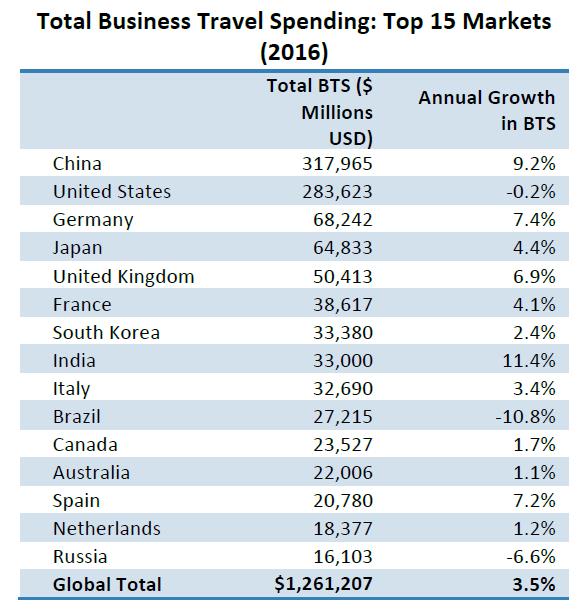
Chart courtesy of the Global Business Travel Association
2 min to read
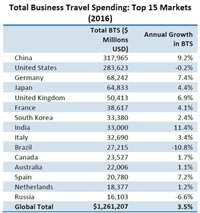
Chart courtesy of the Global Business Travel Association
Global business travel spend approached $1.3 trillion USD in 2016, advancing only 3.5% over 2015 levels, according to the “GBTA BTI Outlook – Annual Global Report & Forecast,” a new report released by the Global Business Travel Association (GBTA) Foundation.
For the second straight year in 2016, China topped the charts, surpassing the United States as the largest business travel market in the world, according to the report. The top 15 remained unchanged from last year — with the exception of India increasing two spots.
Pending many global uncertainties, business travel spending is expected to accelerate significantly in 2018, advancing 6.1%, followed by roughly 7% growth in both 2019 and 2020, according to the report. Business travel spending gains have not reached this level since 2011.
“Global business travel remains a critical driver of the success of organizations around the globe,” said Michael W. McCormick, GBTA’s chief operating officer and executive director. “Stronger footing in emerging markets and continued economic stimulus in the developed world has supported global stability leading to a positive forecast that is unfortunately clouded with more uncertainty than we have seen in decades.”
According to the report, many signs show the global economy is improving. Consumers are spending, trade and investment are on the rise, corporate profits and management sentiment are strong, commodity prices have stabilized, recessions in Brazil, Russia, and Argentina have ended, and China’s soft landing continues.
Taking these factors into account, business travel growth looks solid over the coming years; however, uncertainty still abounds. Political polices, geopolitical tensions, and financial concerns have intensified, according to the report. The Global Economic Policy Uncertainty Index, which began in 1997, has hit an all-time, 20-year high.
Some sources of uncertainty could ultimately have a positive impact on business travel as lower corporate tax rates are pushed forward and business regulations are rolled back as infrastructure investment increases around the globe, says the report. Other factors will have a more negative impact on business travel, including trade policy renegotiation, terrorism, travel and immigration bans, sanctions, electronics bans, and geopolitical tensions.
More Rental Operations
Direct, Broker or Hybrid? How Travel Retailers Source Rental Cars
As travel retailers weigh direct supplier relationships against third-party distribution, rental operators need to understand how those decisions affect their business.
Read More →
How Did This Independent Rental Operator Grow to 170 Vehicles in 4 Years?
With 170 vehicles across three Kentucky locations, Joel Price relies on an overseas team to handle reservations, payments, and after-hours customer service. It's one part of an unconventional approach to growing an independent rental operation.
Read More →
What Does It Take to Succeed in B2B Rentals?
The fundamentals may be familiar to daily car rental operators, but project-based truck rentals put different demands on the fleet and the business.
Read More →
NPR Builds on International Partnerships to Grow Rental Bookings
With Ana Laborde supporting broker development, NPR Auto Group is tailoring distribution strategies, rate packages, and partnerships to grow international reservations across its three brands.
Read More →
Advantage, Sixt Place Among Top Five in Annual Satisfaction Study
While Enterprise and National retain the top spots in JD Power’s 2026 rankings, the latest customer satisfaction results suggest renters can find competitive service beyond the biggest car rental names.
Read More →
The $100,000 Insurance Trap in Exotic Car Rentals
Exotic rental agencies often rely on customers’ personal auto policies to protect six-figure vehicles. But policy language can dramatically change the coverage for vehicles over $100,000 MSRP.
Read More →
The Booking Is Confirmed, But Is Your Customer Ready to Drive?
For international renters, a confirmed reservation doesn’t always mean they’re eligible to drive. Earlier checks can help operators catch documentation and payment issues before the customer reaches the counter.
Read More →
ICRS 2027 Opens Call for Papers
The International Car Rental Show seeks session proposals on the business, operational, and technology issues facing car rental operators. Submissions are due Jan. 15.
Read More →
Turo to Launch Vehicle Delivery Service
Turo Delivered will let travelers search for vehicles that hosts can deliver directly to hotels, homes, airports, train stations, and other locations.
Read More →
Palm Beach Airport Code Change Creates Car Rental Distribution Gap
A test of rental searches under the old PBI and new DJT airport codes returned largely different sets of brands and vehicles, highlighting a potential distribution problem for rental operators.
Read More →