



Related: Election, Global Uncertainty Contribute to Sluggish Business Travel Spending
European Travelers Expect Reduction in U.S. Business Travel
According to a poll by the Global Business Travel Association (GBTA), 47% of European travel professionals expect some reduction in U.S. business travel for their company following President Trump’s executive order on travel.
by Staff
March 20, 2017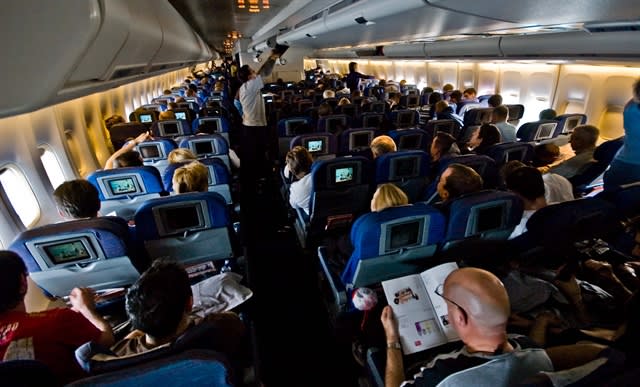
Photo via Wikimedia/Rene Ehrhardt
3 min to read
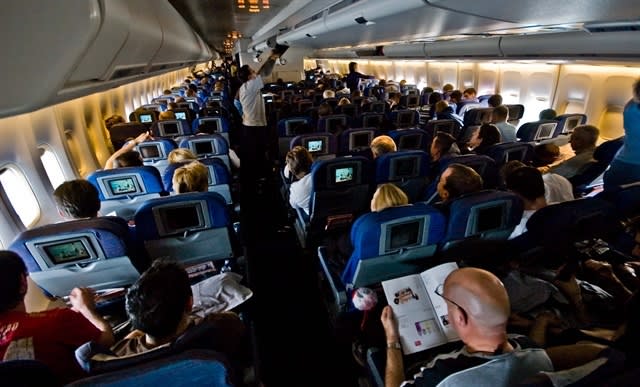
Photo via Wikimedia/Rene Ehrhardt
The Global Business Travel Association (GBTA) polled its U.S. and European members to assess the business travel impact of President Trump’s revised executive order on travel.
Nearly 4 in 10 (37%) U.S. business travel professionals expect some level of reduction in their company’s travel because of the revised executive order. Even more European travel professionals felt this way — with 47% expecting some level of reduction in business travel for their company.
Additionally, 17% of European travel professionals reported that their company has already cancelled U.S. business travel because of the executive orders issued, according to the poll.
Thirty-eight percent of European business travel professionals said their company’s would be less willing to send business travelers to the U.S. in the future because of the executive order and 45% indicated their company will be less willing to plan future meetings and events in the U.S., according to the poll.
“There is always the risk that closing our borders sends the message that the United States is closed for business, and the results of this poll show the perception of the United States as a welcoming destination for business travel has been altered,” said Michael W. McCormick, GBTA’s executive director and COO. “As we always say, security is paramount, but GBTA continues to be a proponent for expanding proven security programs and developing new technology to facilitate information-sharing among governments to ensure travelers are always vetted properly, making us all more safe and secure.”
According to the poll, here are other highlights:
• 44% of European travel professionals reported their organization currently has employees traveling abroad who might be or are affected by the current travel ban.
• 20% of European travel professionals reported there are directives within their organization to cancel or delay travel of employees who are nationals of countries included in the ban.
• U.S. travel professionals cited potential for countries to respond to this ban, making travel more difficult for U.S. travelers (51%), complications in travel to the United States (44%), and increased threats against U.S. travelers abroad (41%) as their top concerns for lasting impacts of the travel ban.
• When asked about top concerns regarding the immigration ban on your travelers, increased traveler harassment in general (41%), uncertainty regarding green card and approved visa credibility to enter the U.S. (34%), and harassment of U.S. travelers to and from the Middle East (34%) topped the list. More than one-third (34%), however, didn’t share any of the concerns listed.
The poll of European members was conducted online between March 7 and 8, 2017. The respondents are comprised of 148 European travel managers, 51 of whom reside in Nordic countries (Denmark, Finland, Norway, or Sweden). The poll of U.S. members was also conducted online between March 7 and 8 and is comprised of 176 travel managers.
More Rental Operations
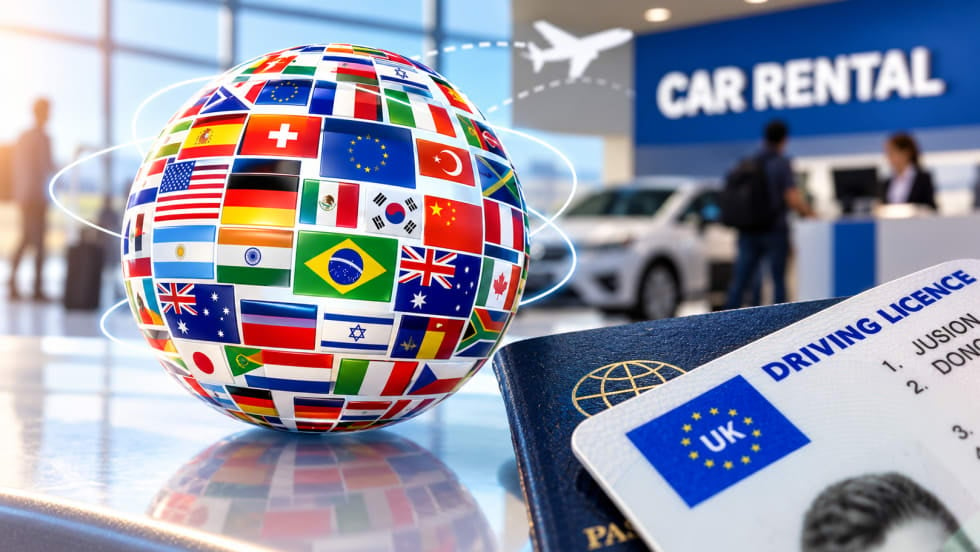
The Booking Is Confirmed, But Is Your Customer Ready to Drive?
For international renters, a confirmed reservation doesn’t always mean they’re eligible to drive. Earlier checks can help operators catch documentation and payment issues before the customer reaches the counter.
Read More →
ICRS 2027 Opens Call for Papers
The International Car Rental Show seeks session proposals on the business, operational, and technology issues facing car rental operators. Submissions are due Jan. 15.
Read More →
Turo to Launch Vehicle Delivery Service
Turo Delivered will let travelers search for vehicles that hosts can deliver directly to hotels, homes, airports, train stations, and other locations.
Read More →
Palm Beach Airport Code Change Creates Car Rental Distribution Gap
A test of rental searches under the old PBI and new DJT airport codes returned largely different sets of brands and vehicles, highlighting a potential distribution problem for rental operators.
Read More →
U-Save Continues Dominican Republic Expansion with Launch in Punta Cana
The new franchise location builds on U-Save’s existing Santo Domingo operation and will begin taking reservations for October 2026.
Read More →
When AI Books the Rental Car, Who Controls the Sale?
As AI moves from comparing rental rates to completing transactions, operators need to understand how travelers find, interpret, rank, and ultimately see their offers. (Part 2 of 2.)
Read More →
European Booked Car Rental Rates Fell 5%, Results Varied by Country
Ireland, Cyprus, and the United Kingdom saw steep declines, while booked rates rose in Poland and Hungary.
Read More →
Is It Time to Rethink Rental Categories?
As traditional economy and compact cars disappear from the market, longtime rental operator Mike DeLorenzo asks whether the industry’s familiar vehicle categories still make sense — and what operators need to rethink along with them.
Read More →
Who Owns the Rate? AI Is Creating a New Distribution Problem for Car Rental
Generative Engine Optimization asks whether AI can find a rental company, but operators also need to know whether the agent inspected enough of the market, compared equivalent offers, and presented a rate the traveler can actually book. (Part 1 of 2)
Read More →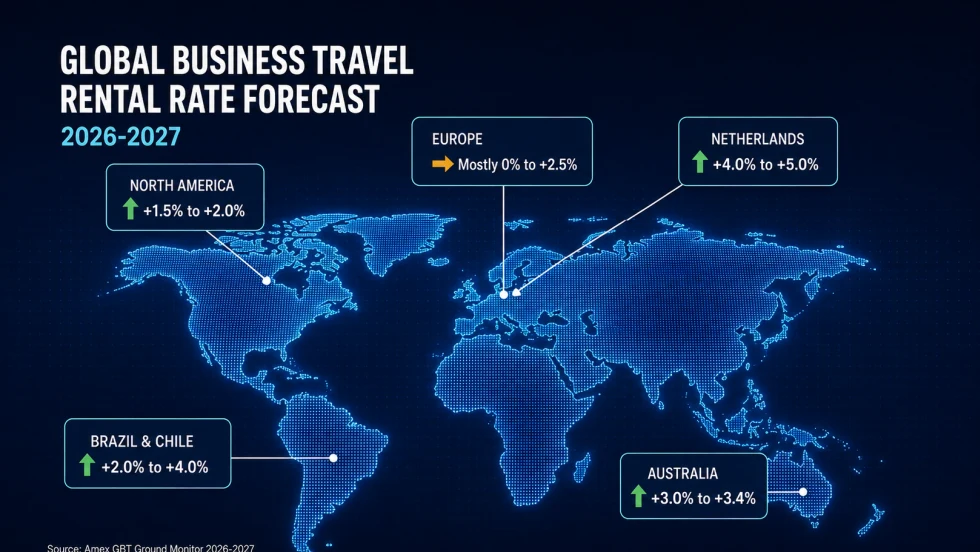
U.S. Business Travel Car Rental Rates Forecast to Rise Up to 2%
Improved fleet supply should limit pricing gains in 2026-27, while insurance, repair costs, and softer residual values continue to pressure rental operations, according to Amex GBT.
Read More →