




Most Fleets Back to Work, Though Future Uncertainty Remains
An average of 80% of fleets and the mobility community are back at work full time and 90% believe their company will survive through the pandemic, although they face major income loss. Many are unsure when business would operate at “normal” levels.

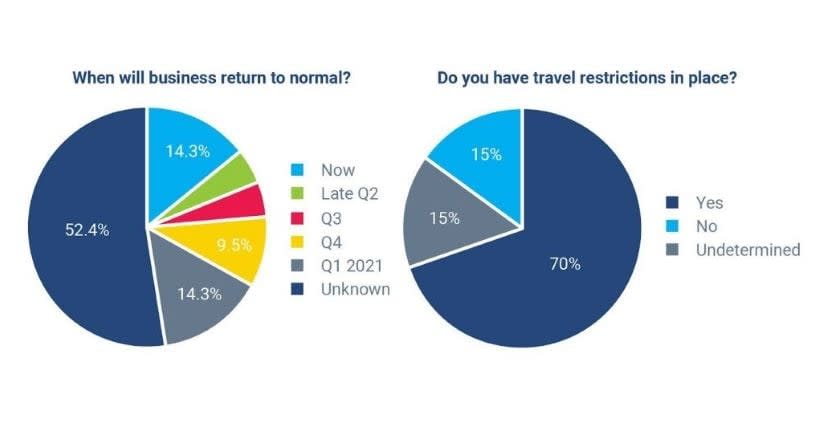
Roughly 52.4% of survey respondents were unsure of when their business would be operating at “normal” levels. The survey also found travel had been significantly reduced and were unsure as to when it would return to normal.
Graphs: Geotab
An average of 80% of fleets and the mobility community are back at work full time, and 90% believe their company will survive through the pandemic, although they face major income loss, according to data from Geotab. However, 52.4% of survey respondents were unsure of when their business would be operating at “normal” levels.
Companies and their fleet operations will continue to focus on asset utilization, productivity and efficiency, and cost reduction measures, regardless of their financial impact resulting from global economic slowdowns, according to Industry Pulse Checks from Geotab that measured fleet activity and analyzed 24 specific industries.
The pulse check also found that respondents said travel had been significantly reduced and were unsure as to when it would return to normal. This meant there would be more engagement with webinars and fewer face-to-face meetings, which also meant a reduction in miles driven for fleets.
Geotab also reported that companies would be incorporating cost-cutting measures for 2020-2021, which means fleet utilization will be critical; and fleets may look to operate with fewer vehicles.
The Pandemic's Impact on Various Industries
The healthcare industry has been severely impacted, due to demand for essential workers, caregivers and personal protective equipment and supplies surges, the report from Geotab found. Impacts have been severe in both areas of COVID-19 related healthcare and non-essential healthcare. Most healthcare industry companies are anticipating a substantial decline in profit margins for the remainder of this year.
Last-mile delivery companies have seen an exceptional increase in business due to COVID-19. These companies are in constant communication with their supply chain to ensure timely product deliveries to keep up with demand. The demand for everyday items has seen more of an increase than for standard items like electronics.
Meanwhile, government fleets have established two-pronged response to this pandemic, Geotab said, Most state/provincial/local agency fleets (police, fire, EMS, DOT, and general service fleets) are operating at over-capacity in response to new COVID-19 related activities, while others (DOE and school buses, parks and recreation) are shut down. Federal fleet activities seem to be largely unaffected, although a disruption in OEM vehicle deliveries have resulted in significant challenges to leasing and rental operations (GSA).
Overall, long-haul fleets are showing true optimism for freight demand again in the past couple weeks since COVID-19 and its impact on fleet operations. The majority of fleets expect to see a continued increase of freight levels over the next 30-90 days, while only a very few mostly smaller fleets expect to see a decrease.
In the first few months after lockdown, the rideshare, carshare, and car rental industries saw 70%-90% reduction in business. Predictions are that business travel will not recover to pre-pandemic levels due to the growing acceptance of video chat meetings. This anticipated drop in business travel will have a long lasting impact on the car rental industry due to its heavy reliance on business travel, particularly from airports.
Meanwhile, the construction industry was reported to have been one of the few industries that has been able to maintain business and continue working during the COVID-19 crisis, Geotab reported. Indications from companies surveyed all felt that, in the short term, there has been little impact on the state of the business. However, in the longer term, there is concern with regards to existing contract work that has been keeping their workers employed and on the job site during this time.
For insurance companies, overall, staff that manage claims show that vehicle activity slowed down tremendously during the latter half of March and early April during COVID-19 and are slowly recovering. With the percentage of vehicle activity in this sector in February ranging from 60%-78% and dropping in early June to ranges of 29%-55% for fleet utilization.
Meanwhile, for oil and gas companies, prices were already suppressed by global competition prior to COVID-19, and the shutdown exacerbated the problem via an instantaneous and unprecedented drop in demand. This caused issues related to where to store excess oil and a rapid drop in prices that were not sustainable for many smaller exploration companies that had a heavy debt load.
More Detailed Data
Companies also said they would begin implementing new corporate safety policies, which would lead to a need for technology to enable compliance. Additional analysis conducted by Nexus Communication that was presented in the pulse check found that clients are wanting advice and innovation above all else from their suppliers, followed by more communication.
With regards to overall business impact from the pandemic, the pulse check found:
47.6% of companies had significant impact to their business.
28.6% of respondents said they had little impact to their business.
43.3% of respondents said competitors have been significantly impacted.
Uncertainty remains for the operational impact as 57.1% of respondents said it was unknown at this time if they would have additional reduction in workforce in the next six months. And, with regards to financial impact, 42.3% of respondents said the pandemic had significant impact to their customer base.
From the bellwether companies identified and who have participated in the study, all but one were fleets with at least more than 500 vehicles, with a majority of vehicles operating in the U.S.
Originally posted on Automotive Fleet
More Rental Operations

What Does It Take to Succeed in B2B Rentals?
The fundamentals may be familiar to daily car rental operators, but project-based truck rentals put different demands on the fleet and the business.
Read More →
NPR Builds on International Partnerships to Grow Rental Bookings
With Ana Laborde supporting broker development, NPR Auto Group is tailoring distribution strategies, rate packages, and partnerships to grow international reservations across its three brands.
Read More →
Advantage, Sixt Place Among Top Five in Annual Satisfaction Study
While Enterprise and National retain the top spots in JD Power’s 2026 rankings, the latest customer satisfaction results suggest renters can find competitive service beyond the biggest car rental names.
Read More →
The $100,000 Insurance Trap in Exotic Car Rentals
Exotic rental agencies often rely on customers’ personal auto policies to protect six-figure vehicles. But policy language can dramatically change the coverage for vehicles over $100,000 MSRP.
Read More →
The Booking Is Confirmed, But Is Your Customer Ready to Drive?
For international renters, a confirmed reservation doesn’t always mean they’re eligible to drive. Earlier checks can help operators catch documentation and payment issues before the customer reaches the counter.
Read More →
ICRS 2027 Opens Call for Papers
The International Car Rental Show seeks session proposals on the business, operational, and technology issues facing car rental operators. Submissions are due Jan. 15.
Read More →
Turo to Launch Vehicle Delivery Service
Turo Delivered will let travelers search for vehicles that hosts can deliver directly to hotels, homes, airports, train stations, and other locations.
Read More →
Palm Beach Airport Code Change Creates Car Rental Distribution Gap
A test of rental searches under the old PBI and new DJT airport codes returned largely different sets of brands and vehicles, highlighting a potential distribution problem for rental operators.
Read More →
U-Save Continues Dominican Republic Expansion with Launch in Punta Cana
The new franchise location builds on U-Save’s existing Santo Domingo operation and will begin taking reservations for October 2026.
Read More →
When AI Books the Rental Car, Who Controls the Sale?
As AI moves from comparing rental rates to completing transactions, operators need to understand how travelers find, interpret, rank, and ultimately see their offers. (Part 2 of 2.)
Read More →