




Related: Traditional and Peer-to-Peer: Let's Work Together for Better Regulation
Mercury Insurance Offers Coverage for Uber, Lyft Drivers
Mercury Insurance’s new coverage will provide Uber and Lyft drivers with insurance that will cover them throughout the entire ride cycle, including when the ride-hailing app is on but they hadn’t accepted a ride.
by Staff
February 2, 2016
Mercury Insurance is now offering coverage to Transportation Network Company drivers like Lyft in California. Photo courtesy of Lyft.
3 min to read

Mercury Insurance is now offering coverage to Transportation Network Company drivers like Lyft in California. Photo courtesy of Lyft.
Mercury Insurance is now offering ride-hailing insurance to cover Uber, Lyft and other Transportation Network Company (TNC) drivers.
This new coverage will provide drivers with insurance that will bridge the gap between their personal auto insurance and the coverage provided by their TNC, according to Mercury.
In the past, ride-hailing drivers have been left without coverage by their insurance companies if they got into an accident while their ride-hailing app was on but they hadn't accepted a ride. This new coverage will close that gap and provide drivers with access to coverage throughout the entire ride cycle, says Mercury. Previously, drivers were only covered by TNC commercial insurance once they accepted a ride.
"Many Californians enjoy driving for companies like Uber and Lyft as a great way to earn a living or make extra cash because they can set their own hours, be their own bosses and meet new people," said Jim Reeves, Mercury's research and development group manager. "Many of them are unknowingly putting themselves and other drivers at risk, however, because they don't have adequate insurance coverage in the event they get into an accident when their app is on, but they haven't accepted a ride."
"Mercury wants to ensure these individuals are able to earn an honest living without having to worry about paying costly repair or medical bills out-of-pocket — and we'll be able to offer this peace of mind for as little as 20 cents a day," added Reeves.
Ride-hailing is divided into three phases:
• Phase one: Drivers have turned on the ride-hailing app but haven't accepted a fare.
• Phase two: Drivers have accepted a fare and are on their way to pick up the passenger(s).
• Phase three: Drivers are transporting passengers to their destinations.
Mercury's ride-hailing insurance will cover drivers during the first phase of their trip. This coverage is not provided by personal auto policies, and the TNCs provide limited coverage during this phase, too, according to Mercury. This means that if drivers get into an accident during phase one, they will have to pay to repair any damages to their vehicles — the TNC liability coverage is capped at $50,000 per person and $100,000 per accident for injury to others.
Mercury's ride-hailing insurance will provide additional coverage beyond the TNC coverage, and it will also fix the insured's vehicle in a covered loss if those coverages had been purchased from Mercury, says the company.
"Mercury has been protecting drivers for more than 50 years. It's what we do,” said Reeves. “So, we're very excited to be one of the first companies to extend the coverage to ride-hailing drivers and protect not only them, but the drivers and families with which they come in contact on the road."
Currently, Mercury's ride-hailing insurance is only available to California ride-share drivers. For more information, visit www.mercuryinsurance.com/ride-hailing-insurance/california.html.
More Rental Operations

The Booking Is Confirmed, But Is Your Customer Ready to Drive?
For international renters, a confirmed reservation doesn’t always mean they’re eligible to drive. Earlier checks can help operators catch documentation and payment issues before the customer reaches the counter.
Read More →
ICRS 2027 Opens Call for Papers
The International Car Rental Show seeks session proposals on the business, operational, and technology issues facing car rental operators. Submissions are due Jan. 15.
Read More →
Turo to Launch Vehicle Delivery Service
Turo Delivered will let travelers search for vehicles that hosts can deliver directly to hotels, homes, airports, train stations, and other locations.
Read More →
Palm Beach Airport Code Change Creates Car Rental Distribution Gap
A test of rental searches under the old PBI and new DJT airport codes returned largely different sets of brands and vehicles, highlighting a potential distribution problem for rental operators.
Read More →
U-Save Continues Dominican Republic Expansion with Launch in Punta Cana
The new franchise location builds on U-Save’s existing Santo Domingo operation and will begin taking reservations for October 2026.
Read More →
When AI Books the Rental Car, Who Controls the Sale?
As AI moves from comparing rental rates to completing transactions, operators need to understand how travelers find, interpret, rank, and ultimately see their offers. (Part 2 of 2.)
Read More →
European Booked Car Rental Rates Fell 5%, Results Varied by Country
Ireland, Cyprus, and the United Kingdom saw steep declines, while booked rates rose in Poland and Hungary.
Read More →
Is It Time to Rethink Rental Categories?
As traditional economy and compact cars disappear from the market, longtime rental operator Mike DeLorenzo asks whether the industry’s familiar vehicle categories still make sense — and what operators need to rethink along with them.
Read More →
Who Owns the Rate? AI Is Creating a New Distribution Problem for Car Rental
Generative Engine Optimization asks whether AI can find a rental company, but operators also need to know whether the agent inspected enough of the market, compared equivalent offers, and presented a rate the traveler can actually book. (Part 1 of 2)
Read More →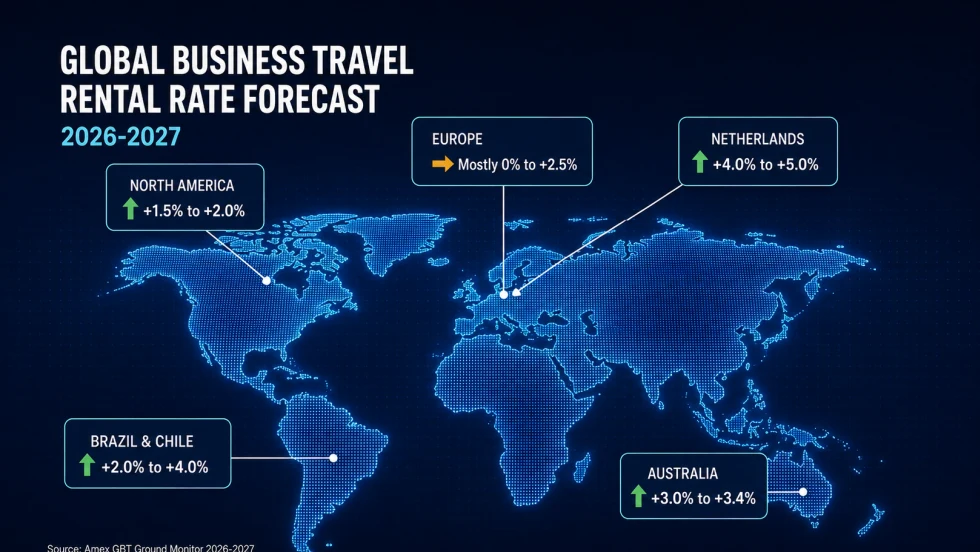
U.S. Business Travel Car Rental Rates Forecast to Rise Up to 2%
Improved fleet supply should limit pricing gains in 2026-27, while insurance, repair costs, and softer residual values continue to pressure rental operations, according to Amex GBT.
Read More →